
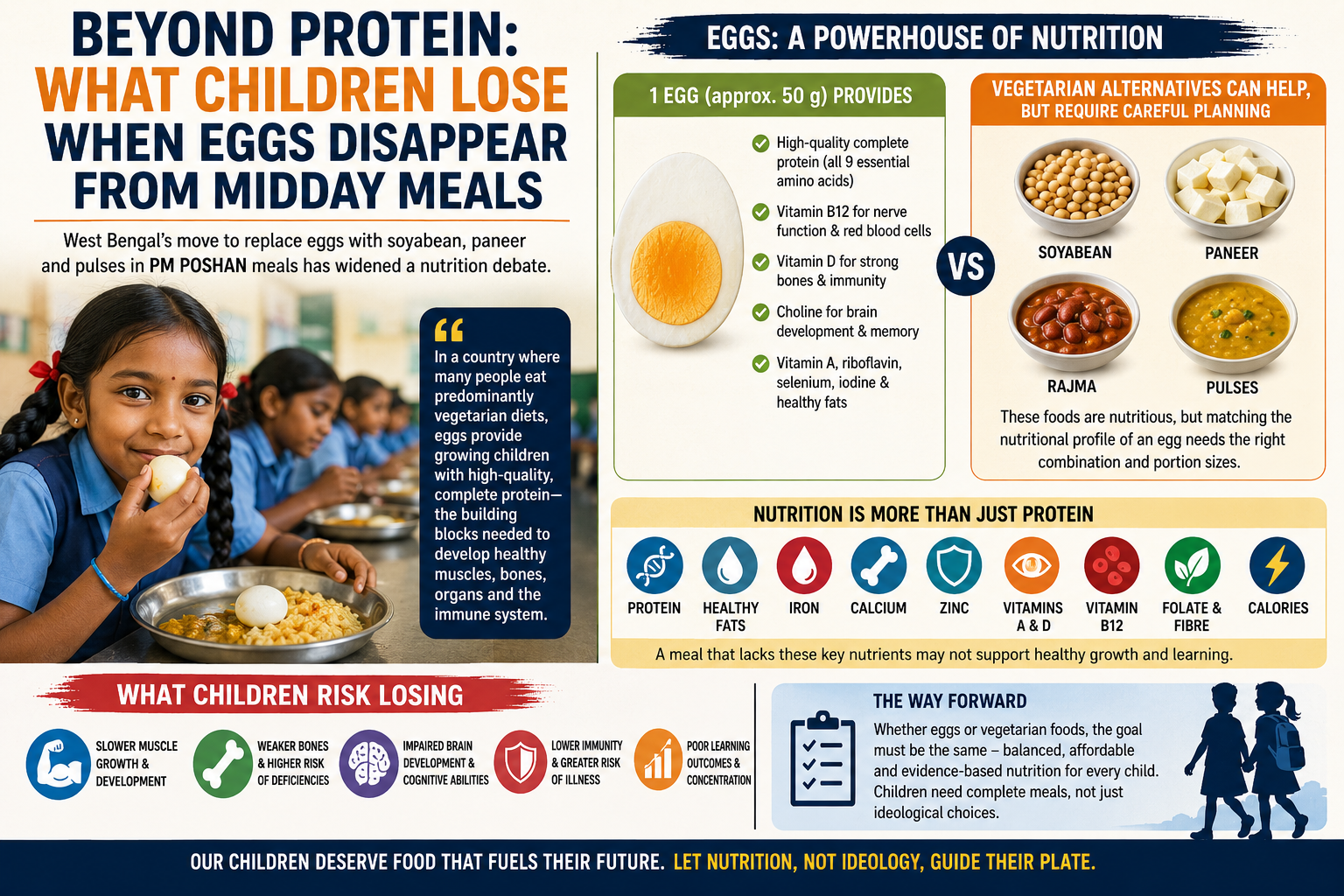
The recent debate over replacing eggs with vegetarian alternatives such as soyabean, paneer, rajma, and pulses in parts of West Bengal’s PM POSHAN (formerly Mid-Day Meal) programme has reignited a long-standing discussion about child nutrition in India. While the issue has attracted political attention, it also raises an important public health question: what role do eggs play in the diets of school-going children, and can vegetarian alternatives provide the same nutritional benefits?
India continues to face significant challenges related to childhood malnutrition, stunting, anaemia, and protein deficiency. For millions of children attending government schools, the midday meal is not merely a school lunch—it is often one of the most nutritious meals they receive in an entire day. As a result, any change in its composition deserves careful evaluation based on nutritional science rather than ideology alone.
Why Midday Meals Matter
The PM POSHAN scheme is one of the world’s largest school feeding programmes, covering millions of students studying in government and government-aided schools. Beyond reducing classroom hunger, the programme aims to improve nutritional status, encourage school attendance, reduce dropout rates, and support children’s physical and cognitive development.
The scheme specifies nutritional targets for calories and protein, while individual states have flexibility in deciding the menu based on local food habits, availability, and cultural preferences.
For many economically disadvantaged families, the school meal supplements daily nutrition that may otherwise be inadequate.
Eggs: More Than Just a Source of Protein
Eggs are often described as one of nature’s most complete foods. Although they are widely recognised for their high-quality protein, their nutritional value extends much further.
An egg contains all nine essential amino acids in proportions that support growth and tissue repair. Since the human body cannot produce these amino acids on its own, they must come through food. This makes eggs particularly valuable during childhood, when muscles, bones, organs, and the immune system are developing rapidly.
In addition to protein, eggs provide important nutrients such as vitamin B12, vitamin D, vitamin A, riboflavin, choline, selenium, iodine, and healthy fats. Choline is especially important for brain development and memory, while vitamin B12 supports healthy nerve function and red blood cell formation.
These nutrients work together to support growth, immunity, learning, and overall health.
Can Vegetarian Alternatives Replace Eggs?
The proposed alternatives—including soyabean, paneer, rajma, and pulses—are all nutritious foods and can contribute significantly to children’s diets.
Soyabean is unique among plant foods because it contains all essential amino acids, making it a complete plant protein. Paneer offers high-quality dairy protein along with calcium, while pulses and beans provide protein, dietary fibre, iron, folate, and other micronutrients.
However, nutrition experts note that matching the nutritional profile of an egg requires careful meal planning. Eggs naturally combine complete protein with several essential vitamins and minerals in a single affordable serving.
Plant-based meals can provide comparable nutrition, but they often require combining different ingredients in appropriate quantities to achieve similar protein quality and micronutrient intake.
Therefore, the effectiveness of vegetarian alternatives depends not only on the ingredients selected but also on portion size, preparation methods, and overall meal quality.
Protein Quality Matters
When discussing children’s nutrition, the quality of protein is as important as the quantity.
Proteins are made up of amino acids, and foods differ in how efficiently the body can use them. Animal-based proteins such as eggs generally have high digestibility and provide all essential amino acids in optimal proportions.
Many plant proteins are nutritious but may contain lower amounts of one or more essential amino acids. Soyabean is an exception because it offers a complete amino acid profile. Combining cereals, pulses, dairy products, and soy can also improve the overall quality of protein in vegetarian diets.
This is why dietitians recommend looking at the total composition of a meal rather than focusing on a single ingredient.
Nutrition Goes Beyond Protein
While the debate often centres on protein, children need a balanced intake of many nutrients to grow and learn effectively.
School meals should ideally provide:
-
High-quality protein
-
Healthy fats
-
Iron
-
Calcium
-
Zinc
-
Vitamin A
-
Vitamin D
-
Vitamin B12
-
Folate
-
Dietary fibre
-
Adequate calories
A meal that meets protein targets but lacks important micronutrients may not fully support healthy development.
This highlights the importance of designing menus based on comprehensive nutritional requirements rather than on any single nutrient.
The Importance of Choice and Local Context
India is home to diverse dietary traditions. While many families consume eggs regularly, others follow vegetarian diets due to cultural, religious, or personal preferences.
Public nutrition programmes therefore face the challenge of balancing nutritional goals with community preferences.
Several states have addressed this by offering eggs where acceptable while providing nutritionally comparable vegetarian alternatives for students who choose not to consume them. Such an approach respects dietary diversity while ensuring that children’s nutritional needs remain the central priority.
What Nutrition Experts Recommend
Nutrition specialists generally agree on several key principles.
First, children’s diets should be designed to meet scientifically established nutritional requirements.
Second, food choices should be guided by health outcomes rather than ideology alone.
Third, when eggs are replaced, vegetarian alternatives should be carefully planned to ensure they provide sufficient protein, calories, vitamins, and minerals.
Finally, regular monitoring of children’s nutritional status is essential to evaluate whether school meal programmes are meeting their intended objectives.
The Broader Challenge of Child Nutrition in India
The discussion surrounding eggs also draws attention to larger nutritional challenges.
Many Indian children continue to experience deficiencies in protein, iron, vitamin B12, and other essential nutrients. Anaemia remains a significant public health concern, particularly among children and adolescent girls.
Improving nutrition therefore requires a comprehensive approach that includes diversified diets, fortified foods where appropriate, nutrition education, access to healthcare, and effective implementation of welfare programmes such as PM POSHAN.
Whether meals include eggs or vegetarian alternatives, the ultimate objective should remain improving children’s health and educational outcomes.
Looking Ahead
The current debate presents an opportunity to strengthen conversations around evidence-based nutrition policy.
Rather than framing the discussion as eggs versus vegetarian foods, experts suggest focusing on whether school meals consistently provide complete, balanced, and affordable nutrition for every child.
Both eggs and carefully designed vegetarian meals can contribute to healthy diets. The key lies in ensuring that menu decisions are informed by nutritional science, local needs, affordability, and children’s long-term well-being.
Conclusion
The debate over replacing eggs in school midday meals goes beyond a single food item. It raises fundamental questions about how India can best nourish millions of children who depend on government-supported meals for a significant share of their daily nutrition.
Eggs remain one of the most efficient sources of complete protein and several essential micronutrients. At the same time, vegetarian foods such as soyabean, paneer, pulses, and legumes can also support healthy growth when combined thoughtfully and served in adequate quantities.
Ultimately, the success of any school meal programme should be measured not by whether it is vegetarian or non-vegetarian, but by whether it consistently provides children with the balanced nutrition they need to grow, learn, and thrive.
 Martin