
In today’s digital economy, cybersecurity has evolved from an IT concern into a critical business priority. Organizations rely heavily on cloud computing, remote work technologies, artificial intelligence (AI), connected devices, and digital collaboration tools. While these innovations improve productivity and efficiency, they also create new opportunities for cybercriminals.
The cybersecurity landscape in 2026 is changing faster than ever. Threat actors are using advanced technologies, including AI and automation, to launch more sophisticated attacks. At the same time, businesses must defend increasingly complex digital environments. Understanding emerging threats and adopting modern security practices has become essential for long-term business resilience.
The Evolving Cyber Threat Landscape
Cyber threats are no longer limited to traditional malware or isolated hacking attempts. Modern attackers operate like professional organizations, using automation, intelligence gathering, and highly targeted strategies.
One of the most significant developments is the rise of AI-powered cyberattacks. Artificial intelligence enables attackers to create convincing phishing emails, automate reconnaissance activities, and identify vulnerabilities at a scale that was previously impossible. AI-generated content can closely mimic human communication, making fraudulent messages harder for employees to recognize.
Another growing concern is the expansion of attack surfaces. Businesses now manage data across multiple cloud platforms, remote devices, mobile applications, and third-party vendors. Each connection point represents a potential entry route for attackers. As organizations adopt more digital tools, the challenge of securing every endpoint becomes increasingly difficult.
Cybersecurity experts widely recognize that attackers are becoming faster, more adaptive, and more capable of exploiting human behavior alongside technical weaknesses.
Emerging Cybersecurity Threats Businesses Must Watch
1. AI-Powered Phishing and Social Engineering
Phishing remains one of the most effective cyberattack methods, but AI has dramatically increased its sophistication.
Traditional phishing emails often contained spelling mistakes and obvious warning signs. Modern AI-generated messages can imitate writing styles, company branding, and even internal communications. Attackers can create highly personalized emails using publicly available information, increasing the likelihood that recipients will trust malicious messages.
Deepfake technology adds another layer of risk. Cybercriminals can generate realistic audio and video recordings that imitate executives, managers, or trusted business partners. These fake communications can be used to authorize fraudulent transactions or gain access to sensitive information.
2. Ransomware Evolution
Ransomware continues to be a major threat to organizations of all sizes.
Modern ransomware groups operate as highly organized criminal enterprises. Instead of simply encrypting files, attackers now steal sensitive data before locking systems. Victims face double extortion—paying for system recovery while also attempting to prevent the public release of confidential information.
AI and automation are making ransomware campaigns more efficient. Attackers can rapidly identify vulnerable targets, map networks, and optimize attack timing. This evolution increases both the speed and impact of ransomware incidents.
3. Identity-Based Attacks
Cybersecurity professionals increasingly observe that attackers prefer stealing credentials rather than breaking through technical defenses.
Weak passwords, credential reuse, and compromised login information allow threat actors to gain access using legitimate accounts. Once inside a system, attackers can move through networks while appearing to be authorized users.
Identity-based attacks are particularly dangerous because they often bypass traditional security tools. As a result, businesses must place greater emphasis on identity protection and access management.
4. Supply Chain Vulnerabilities
Organizations rarely operate in isolation. They depend on software providers, cloud vendors, consultants, and other third parties.
Attackers recognize that compromising a trusted supplier can provide access to multiple organizations simultaneously. A vulnerability in one vendor’s system can create widespread security consequences across an entire business ecosystem.
As digital partnerships expand, supply-chain security has become one of the fastest-growing areas of cybersecurity concern.
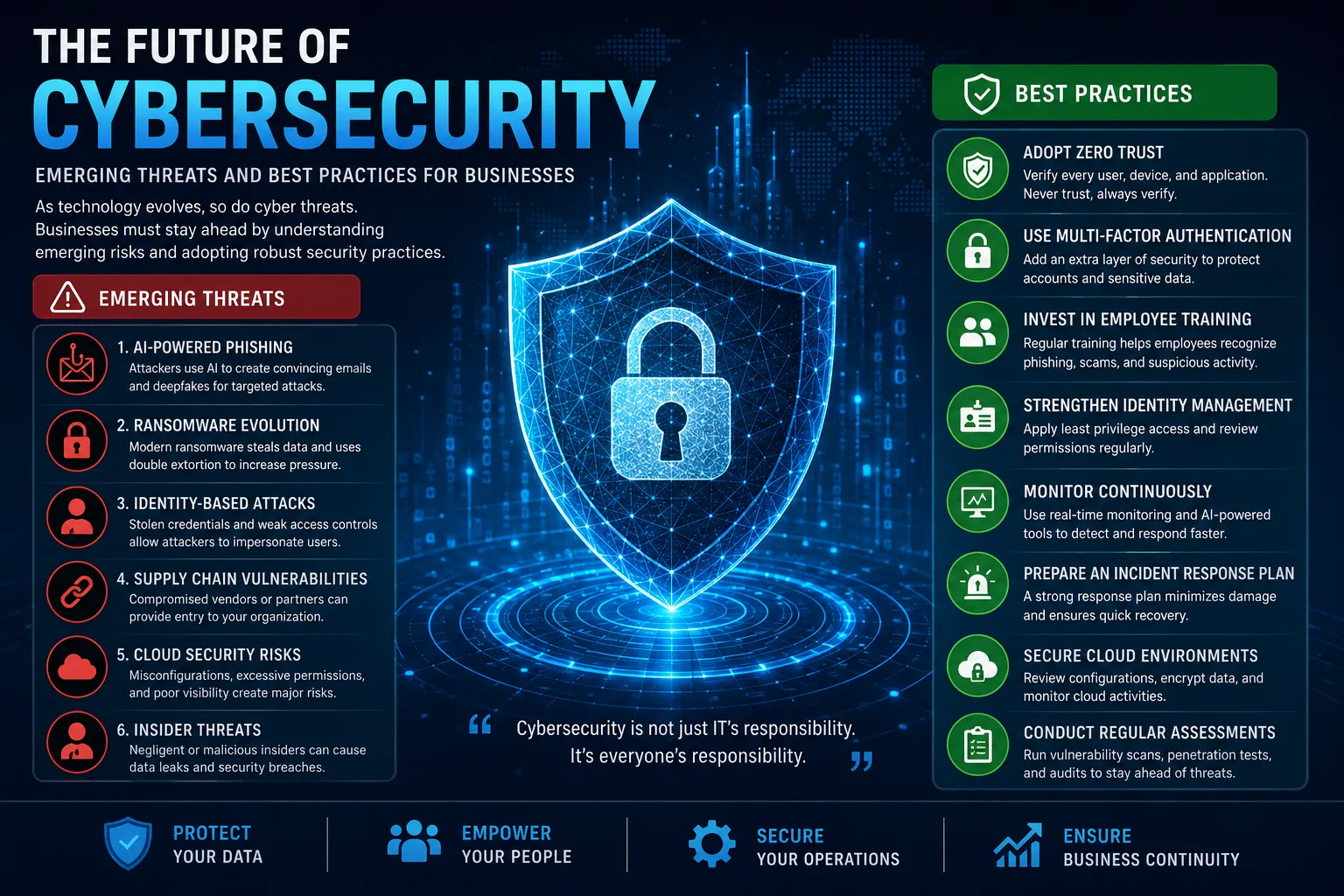
5. Cloud Security Risks
Cloud adoption continues to accelerate across industries. While cloud platforms offer flexibility and scalability, they also introduce unique security challenges.
Misconfigured storage systems, excessive user permissions, and inadequate monitoring remain common causes of cloud-related security incidents. Businesses often struggle to maintain visibility across hybrid and multi-cloud environments, creating opportunities for attackers to exploit unnoticed vulnerabilities.
6. Insider Threats
Not all cybersecurity threats originate from external attackers.
Employees, contractors, and partners may accidentally expose sensitive information through negligence or poor security practices. In some cases, insiders may intentionally misuse access privileges for financial gain or personal motives.
The increasing use of AI tools also raises concerns about accidental data leakage when employees upload confidential information into external platforms without proper safeguards.
Best Practices for Strengthening Business Cybersecurity
While cyber threats continue to evolve, businesses can significantly reduce risk through proactive security measures.
Adopt a Zero Trust Security Model
The traditional approach of trusting users inside a corporate network is no longer sufficient.
Zero Trust assumes that no user, device, or application should be automatically trusted. Every access request must be verified, authenticated, and continuously monitored. This approach reduces the impact of compromised credentials and unauthorized access.
Implement Multi-Factor Authentication
Multi-factor authentication (MFA) remains one of the most effective cybersecurity controls available.
By requiring additional verification beyond a password, MFA dramatically reduces the likelihood of successful credential-based attacks. Businesses should enforce MFA across all critical systems, applications, and administrative accounts.
Invest in Employee Security Awareness
Human error continues to play a significant role in security incidents.
Regular cybersecurity training helps employees identify phishing attempts, suspicious requests, and social engineering tactics. Security awareness programs should be updated frequently to address evolving threats, including AI-generated scams and deepfake communications.
Strengthen Identity and Access Management
Organizations should follow the principle of least privilege, granting employees access only to the resources necessary for their roles.
Regular access reviews, privileged account monitoring, and identity governance policies help reduce the risk of unauthorized activity and credential abuse.
Maintain Continuous Monitoring
Modern cyberattacks can develop rapidly. Businesses need real-time visibility into their environments.
Continuous monitoring, threat detection systems, and security analytics enable organizations to identify unusual behavior before incidents escalate. AI-powered security tools can assist by analyzing large volumes of data and detecting anomalies that human analysts might miss.
Develop an Incident Response Plan
No organization can guarantee complete immunity from cyber threats.
A well-documented incident response plan ensures that teams know how to react during a security event. Effective response procedures can minimize operational disruption, reduce recovery costs, and protect customer trust.
Secure Cloud Environments
Cloud security requires ongoing attention.
Businesses should regularly review configurations, enforce strong access controls, encrypt sensitive data, and monitor cloud activity. Security responsibilities should be clearly defined between organizations and cloud service providers.
Conduct Regular Security Assessments
Routine vulnerability assessments, penetration testing, and security audits help identify weaknesses before attackers do.
Continuous evaluation ensures that security controls remain effective as technology, business processes, and threat landscapes evolve.
Conclusion
The future of cybersecurity will be shaped by a constant battle between innovation and risk. Artificial intelligence, cloud computing, automation, and digital transformation will continue to create opportunities for businesses while simultaneously expanding the capabilities of cybercriminals.
Organizations that view cybersecurity as a strategic business function rather than a technical requirement will be better positioned for success. By adopting modern security frameworks, strengthening identity protection, investing in employee awareness, and preparing for emerging threats, businesses can build resilience in an increasingly complex digital world.
Cybersecurity is no longer just about preventing attacks. It is about ensuring business continuity, protecting customer trust, and enabling sustainable growth in a rapidly evolving technological landscape.