
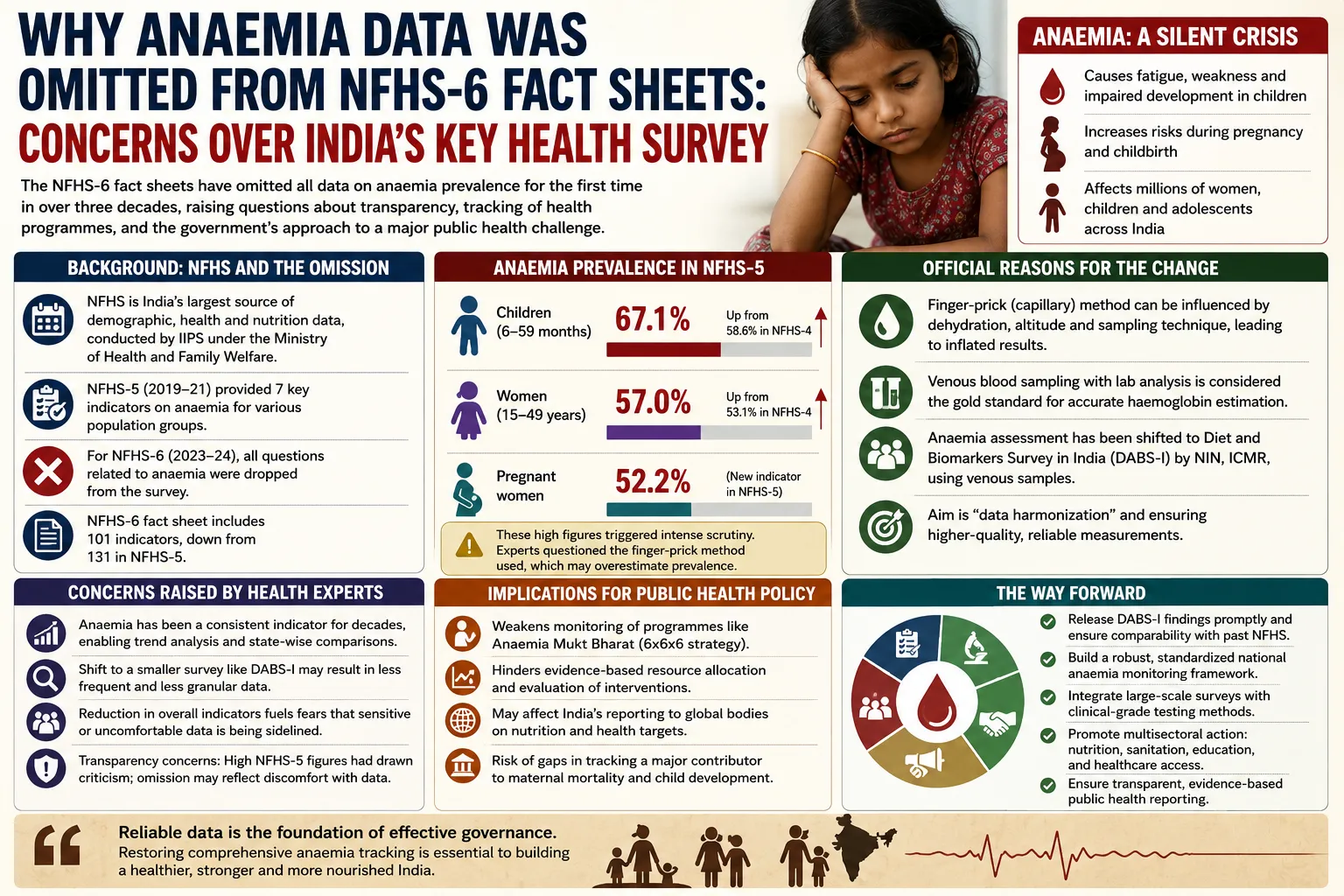
The recent release of the National Family Health Survey-6 (NFHS-6) fact sheets has sparked widespread concern among public health experts, researchers, and policymakers. For the first time in over three decades, the comprehensive national survey has omitted all data related to anaemia prevalence — one of India’s most persistent and widespread public health challenges. This omission raises critical questions about data transparency, the tracking of national health programmes, and the government’s approach to addressing a condition that affects millions of women, children, and adolescents across the country.
Anaemia, characterized by low haemoglobin levels leading to fatigue, weakness, impaired cognitive development in children, and increased maternal risks, has long been a priority for India’s health system. Programmes like Anaemia Mukt Bharat, launched in 2018 under the National Health Mission, aim to reduce its burden through a “6x6x6” strategy targeting children, adolescents, and women. Yet, the absence of updated anaemia statistics in NFHS-6 weakens the ability to measure progress effectively.
Background on NFHS and the Omission
The NFHS is India’s premier source of demographic, health, and nutrition data, conducted periodically by the International Institute for Population Sciences (IIPS) under the Ministry of Health and Family Welfare. Previous rounds, particularly NFHS-5 (2019–21), provided detailed insights into anaemia using seven specific indicators for different population groups.
In NFHS-5, the prevalence of anaemia was alarmingly high: 67.1% among children aged 6–59 months (up from 58.6% in NFHS-4), 57% among women aged 15–49 years (up from 53.1%), and 52.2% among pregnant women. These figures triggered intense scrutiny and debate. Some experts questioned the methodology, arguing that the capillary blood sampling method (finger-prick test) used in the survey tends to overestimate prevalence compared to the more accurate venous blood draw.
As a result, ahead of NFHS-6 fieldwork (launched in 2023), questions related to anaemia were dropped entirely from the survey questionnaire. The latest fact sheet, which contains 101 key indicators compared to 131 in NFHS-5, reflects this deliberate exclusion. Other notable omissions include certain mortality indicators, cancer screening coverage, and HIV awareness metrics, which are now tracked through alternative systems like the Sample Registration System (SRS).
Official Reasons for the Change
Health ministry sources and experts involved in survey design cite methodological improvements as the primary reason. The finger-prick method, while convenient for large-scale field surveys, can be influenced by factors such as dehydration, altitude, and sampling technique, potentially leading to inflated results. Venous blood sampling, drawn from a vein and analyzed in a laboratory using the cyanmethemoglobin method, is considered the gold standard for more reliable haemoglobin estimation.
To address this, the government has shifted anaemia assessment to a specialized survey — the Diet and Biomarkers Survey in India (DABS-I), conducted by the National Institute of Nutrition (NIN) under the Indian Council of Medical Research (ICMR). This dedicated biomarker-focused study is expected to provide more accurate prevalence data using venous samples and is likely to be released soon.
Proponents of this approach argue it represents “data harmonization” — avoiding duplication across surveys and ensuring higher-quality measurements for a complex condition influenced by nutrition, infections, genetics, and socio-economic factors.
Concerns Raised by Health Experts
Many public health specialists view the omission with apprehension. Anaemia has been a consistent indicator in NFHS reports for decades, allowing for state-wise comparisons, trend analysis, and programme evaluation. Removing it from the primary national health survey could create gaps in monitoring the effectiveness of interventions like iron-folic acid supplementation, deworming, and nutrition campaigns.
Critics worry that shifting to a separate, smaller-scale survey like DABS-I may result in less frequent and less granular data. NFHS samples hundreds of thousands of households nationwide, providing robust district- and state-level insights. A narrower biomarker survey might not offer the same breadth or comparability with previous rounds.
There are also broader concerns about transparency. NFHS-5’s high anaemia figures had embarrassed the government amid claims of progress under national nutrition missions. Some analysts suggest the decision reflects discomfort with unflattering statistics rather than purely scientific reasoning. The reduction in overall indicators — from 131 to 101 — has fueled speculation that sensitive or challenging data points are being deprioritized.
Implications for Public Health Policy
Anaemia remains a major barrier to India’s development goals. It contributes to maternal mortality, low birth weight, poor cognitive outcomes in children, and reduced workforce productivity. Without reliable, regular tracking through a flagship survey like NFHS, policymakers may struggle to allocate resources effectively or demonstrate genuine progress to international bodies and the public.
The move also highlights the need for better integration between different health data systems. While the government maintains that alternative sources cover the gaps, independent experts emphasize that a unified, transparent reporting mechanism strengthens accountability.
The Road Ahead
The omission of anaemia data from NFHS-6 should serve as a catalyst for stronger, more accurate surveillance systems. Releasing DABS-I findings promptly and ensuring they are comparable to previous NFHS rounds will be crucial. Long-term, India needs a robust, standardized national anaemia monitoring framework that combines large-scale surveys with clinical-grade testing methods.
On World Environment Day and beyond, addressing anaemia requires not just better data but also multisectoral action — improving dietary diversity, sanitation, women’s education, and access to healthcare. Civil society, researchers, and the media must continue advocating for transparent, evidence-based public health reporting.
The Blue Mountains of the Nilgiris and other ecological concerns often dominate environmental discussions, but underlying human health challenges like anaemia deserve equal attention. Reliable data is the foundation of effective governance. Restoring comprehensive anaemia tracking in future health surveys — or through enhanced specialized studies — will be essential to achieving the vision of a healthier, more nourished India.
As the country moves forward, balancing methodological rigor with the need for timely, actionable insights will determine how successfully India tackles one of its most stubborn public health battles.
 Martin