
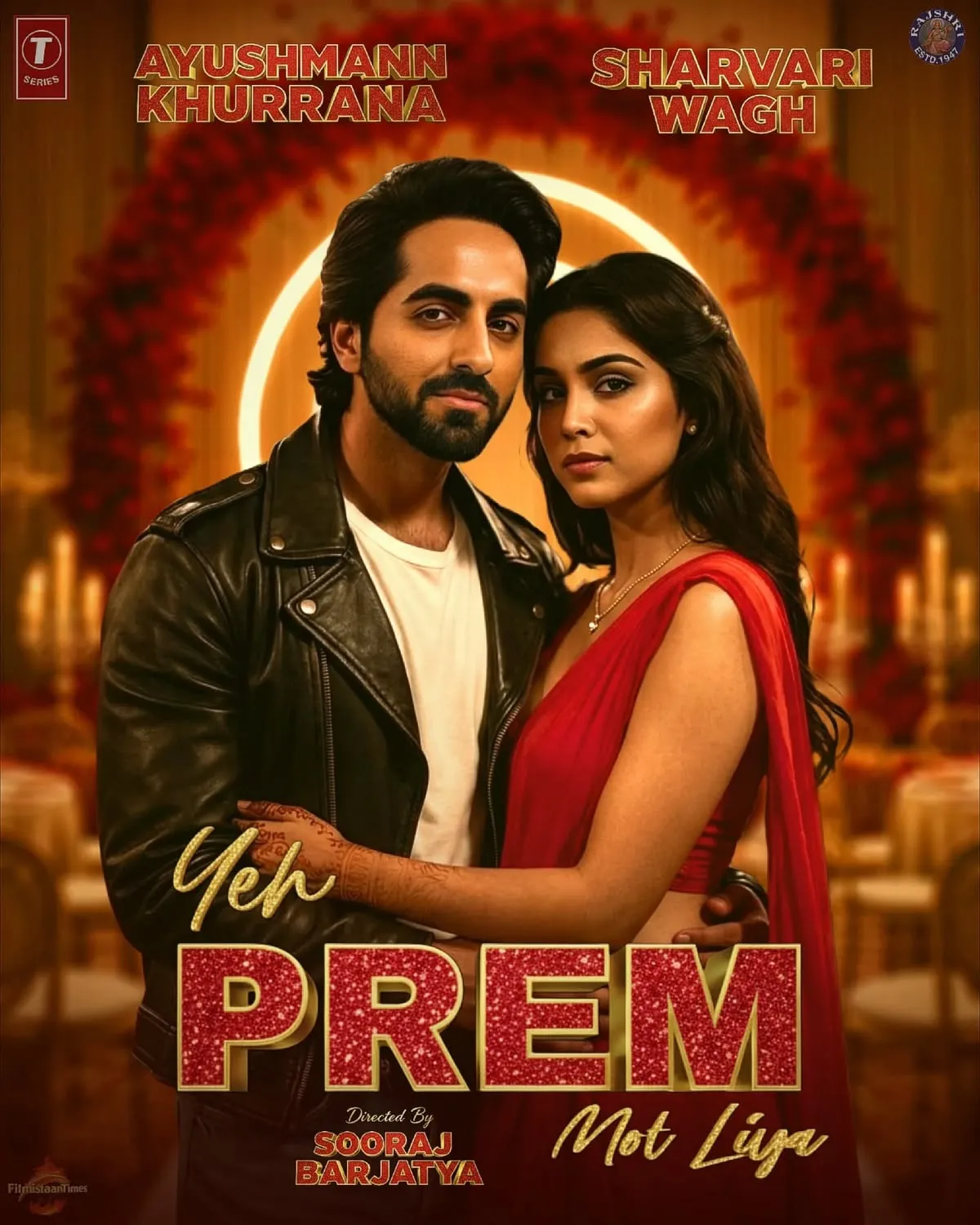
Filmmaker Sooraj Barjatya returns to the big screen with Yeh Prem Mol Liya, a family drama that attempts to bring a fresh perspective to love, marriage and traditional Indian relationships. Starring Ayushmann Khurrana and Sharvari in the lead roles, the film explores an important question: why should marriage always require a woman to leave her family and adjust to her husband’s household?
Known for presenting emotional family stories, wedding celebrations and traditional values, Barjatya takes a slightly different direction with this film. Instead of simply celebrating conventional family structures, he questions some of the social expectations that have shaped Indian marriages for generations.
Ayushmann plays Prem, a sensitive and understanding man who challenges established customs by deciding to move into his wife’s family home after marriage. His decision becomes the central idea of the story and introduces a refreshing version of a modern husband.
The film deserves credit for attempting to discuss gender equality through a mainstream family entertainer. However, despite its progressive message and sincere performances, convenient storytelling and an underdeveloped romance prevent it from reaching its full potential.
What Is the Story of Yeh Prem Mol Liya?
The story follows Prem Mishra, played by Ayushmann Khurrana, an aspiring musician who lives with his family in Mumbai after migrating from Patna. He meets Purva Solanki, played by Sharvari, a young woman who is closely connected to her all-female family.
Purva is hesitant about marriage because she does not want to leave her family behind. Her household depends on her presence, and the traditional expectation that a bride must move into her husband’s home creates a difficult situation for her.
Prem, however, offers an unconventional solution. Instead of asking Purva to adjust to his family’s lifestyle, he decides that he and his family will move into her home after their wedding.
This decision challenges the usual expectations surrounding Indian marriages. It also creates a new situation in which two families with different habits, beliefs and traditions must learn to live together.
The film then explores the adjustments, disagreements and emotional complications that arise when the Mishra and Solanki families share the same household.
Prem Mishra: A New-Age Green Flag in Bollywood
One of the most interesting aspects of Yeh Prem Mol Liya is the character of Prem. In a society where women are frequently expected to compromise after marriage, he represents a different approach to partnership.
He does not consider marriage an arrangement in which only one person must make sacrifices. Instead, he believes that both partners should have equal responsibility for maintaining their relationship and supporting their families.
His willingness to move into Purva’s home challenges the traditional idea of the son-in-law receiving special privileges while the daughter-in-law is expected to adapt to a completely different environment.
Prem’s character also raises important questions about how men are brought up and how family values influence their understanding of relationships. The film suggests that respect, kindness and emotional maturity should be essential qualities in a husband.
Ayushmann Khurrana brings warmth and sincerity to the role. His restrained performance helps Prem appear approachable rather than unnecessarily idealistic. Although the character sometimes feels almost too perfect, Ayushmann makes his intentions believable through his natural screen presence.
The Film Challenges Patriarchy and Traditional Family Expectations
The strongest element of the film is its attempt to question everyday patriarchal practices that are often accepted without discussion.
Why should a woman be the one who changes her surname after marriage? Why is she traditionally expected to leave her parents’ home? Why should responsibility for maintaining relationships between two families fall mainly on the bride?
These are familiar questions, but Indian mainstream cinema has not always placed them at the centre of conventional family entertainment.
Barjatya uses the relationship between Prem and Purva to explore these issues without completely abandoning the family-oriented storytelling associated with Rajshri Productions.
The film also gives the women in Purva’s family their own perspectives and responsibilities. Their presence adds another dimension to the discussion about independence, family expectations and personal choices.
Its central message is that marriage should be based on mutual understanding rather than outdated rules. A successful relationship requires both partners to respect each other’s identities, families and ambitions.
Although the film presents an idealistic situation, its underlying questions are relevant to modern Indian households.
Ayushmann Khurrana and Sharvari’s Performances
Ayushmann Khurrana is one of the film’s biggest strengths. He brings sincerity and emotional warmth to Prem, making the character’s progressive outlook an important part of the story rather than simply a dramatic statement.
Sharvari plays Purva, a woman who is deeply connected to her family but also has her own professional ambitions. She delivers a convincing performance in the emotional portions and brings freshness to the film’s family setting.
However, the relationship between Prem and Purva could have received more attention. Their romance develops rather quickly, leaving limited opportunities for audiences to understand their emotional connection before marriage becomes the central focus.
Anupam Kher adds experience and warmth to the family drama. Supriya Pathak and Seema Pahwa contribute to the film’s familiar family atmosphere, while Saumya Tandon, Shruti Seth and Geeta Agrawal Sharma support the ensemble.
Swanand Kirkire plays Ved Mishra, a character who represents a more rigid understanding of family traditions. His performance is effective, although the writing makes his opposition to Prem’s choices feel somewhat one-dimensional at times.
Where Yeh Prem Mol Liya Loses Its Impact
Despite its meaningful subject, the film struggles with certain aspects of its screenplay.
The biggest problem is the convenient development of the central romance. Prem falls for Purva after a few encounters, and their relationship progresses quickly. While the film establishes Prem as a kind and helpful person, it does not spend enough time developing the deeper emotional connection between the two characters.
The narrative also relies heavily on family disagreements to create drama. Differences involving food preferences, household responsibilities, traditions and beliefs become repeated sources of conflict.
Some of these situations are relatable, but their presentation occasionally feels predictable. Instead of allowing the disagreements to develop naturally, the screenplay sometimes creates conflicts simply to move the story forward.
The first half is also relatively slow, while certain emotional sequences become unnecessarily dramatic. The climax, particularly Prem’s extended monologue, attempts to communicate several important ideas but could have been more effective with a tighter approach.
As a result, the film’s progressive message sometimes gets overshadowed by familiar family-drama storytelling.
Music and Direction Add to the Rajshri Experience
Sooraj Barjatya maintains several elements associated with his filmmaking style. Family gatherings, emotional conversations, celebrations and traditional values remain central to the narrative.
However, the subject gives the film a contemporary identity. Rather than focusing only on romance and family bonding, it encourages viewers to reconsider how marriage traditions can evolve.
Himesh Reshammiya’s music adds to the celebratory atmosphere. Songs such as the title track and Jhumka Patola bring energy to the film, while other compositions complement its emotional and traditional setting.
The overall presentation remains polished, although a shorter and more focused screenplay could have made the storytelling considerably stronger.
Is Yeh Prem Mol Liya Worth Watching?
Yeh Prem Mol Liya is worth considering for audiences who enjoy family-oriented films with emotional themes and meaningful social messages.
The film offers a refreshing idea about marriage and presents a husband who is willing to challenge conventional expectations for the happiness of his partner. Ayushmann and Sharvari also bring sincerity to their respective roles.
However, viewers expecting a tightly written romantic drama may find the storytelling predictable and the first half somewhat slow.
The film’s biggest achievement is starting a conversation about equality, family responsibilities and the importance of respecting both partners after marriage. Its biggest weakness is that the screenplay does not always explore these ideas with the depth they deserve.
Final Verdict
Sooraj Barjatya’s Yeh Prem Mol Liya is an ambitious attempt to combine traditional family entertainment with a modern understanding of marriage. Ayushmann Khurrana’s Prem offers a refreshing example of a supportive partner who believes that relationships should be built on equality rather than inherited expectations.
The film raises important questions about patriarchy, family responsibilities and the sacrifices traditionally expected from women. Sharvari and the supporting cast contribute to its emotional appeal, while Himesh Reshammiya’s music adds to the familiar Rajshri atmosphere.
However, an overly convenient romance, repetitive family conflicts and uneven pacing keep the film from becoming the powerful cinematic experience it aims to be.
Ultimately, Yeh Prem Mol Liya may not be a perfect family drama, but its central message is worth discussing. It reminds viewers that marriage should not be about deciding whose family matters more; it should be about building a partnership in which both families and both individuals receive equal respect.
Read more – grammarfortune.com