
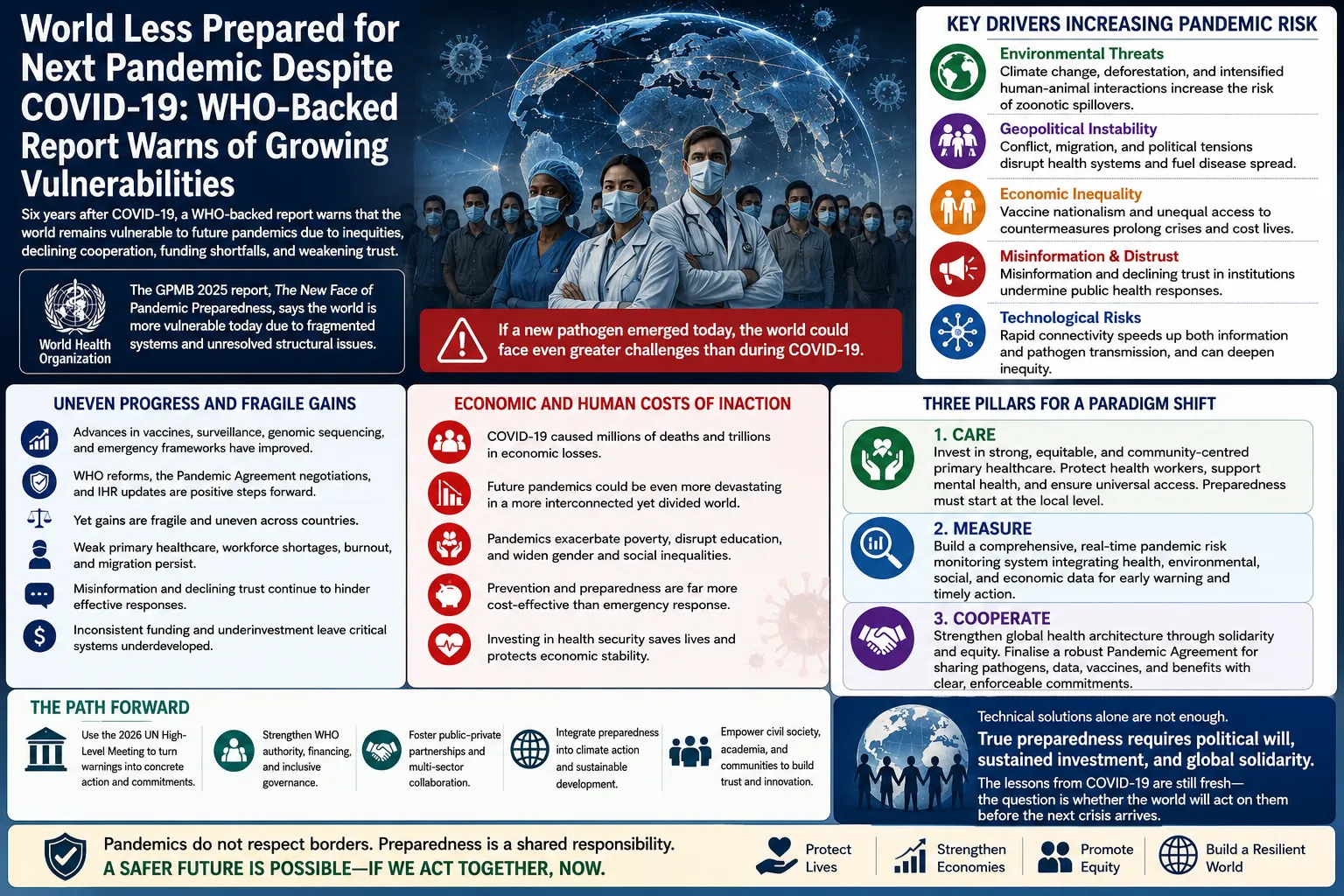
Six years after the COVID-19 pandemic shook the world, a sobering assessment from the Global Preparedness Monitoring Board (GPMB) — an independent body co-convened by the World Health Organization (WHO) and the World Bank — reveals that global health security remains fragile. Despite scientific advances, new tools, and some institutional reforms, the world is arguably more vulnerable to future pandemics than it was before COVID-19 struck. Persistent inequities, declining international cooperation, funding shortfalls, and weakening trust are eroding the hard-won lessons from the deadliest health crisis in a century.
The GPMB’s 2025 report, titled The New Face of Pandemic Preparedness, paints a picture of a world caught between progress and regression. While certain technical capabilities have improved, systemic weaknesses and a fragmented global response system continue to undermine collective resilience. The report warns that if a new pathogen emerged today, the international community could face even greater challenges due to ongoing recovery fatigue and unresolved structural issues.
Uneven Progress and Fragile Gains
COVID-19 triggered unprecedented global collaboration in vaccine development, with platforms like COVAX attempting to ensure equitable distribution. Some countries strengthened their surveillance systems, invested in genomic sequencing, and improved emergency response frameworks. The WHO’s Pandemic Agreement negotiations and updates to the International Health Regulations represent steps toward better coordination.
However, these gains are described as “fragile and uneven.” Many low- and middle-income countries still lack robust primary healthcare systems — the first line of defence against outbreaks. Health workforce shortages persist globally, with burnout and migration of skilled professionals exacerbating gaps. Misinformation and declining public trust in institutions, amplified during the pandemic, continue to hinder effective responses.
The report highlights that political will often fades once immediate crises subside. Funding for preparedness remains inconsistent, with many countries failing to allocate sufficient domestic resources or honour international commitments. This underinvestment leaves critical areas such as laboratory networks, supply chain resilience, and community engagement underdeveloped.
Key Drivers Increasing Pandemic Risk
The GPMB identifies multiple interconnected factors that are heightening global vulnerability. Rapid urbanization, climate change, deforestation, and intensified human-animal interactions are increasing the likelihood of zoonotic spillovers. Geopolitical tensions, conflict, and migration disrupt health services and create fertile ground for disease spread.
Economic inequality remains a core issue. Wealthier nations often secure vaccines and medical countermeasures first, while vulnerable populations in poorer regions face delayed access. This “vaccine nationalism,” witnessed during COVID-19, undermines global solidarity and prolongs pandemics. The report stresses that true preparedness requires addressing social determinants of health, not just medical interventions.
Technological advances, while promising, also introduce new risks. Enhanced connectivity speeds up both information sharing and pathogen transmission. The same tools enabling rapid vaccine development can be misused or create new forms of inequity if access remains restricted by intellectual property barriers or high costs.
Three Pillars for a Paradigm Shift
To reverse this concerning trajectory, the GPMB proposes a fundamental reset anchored in three actions: Care, Measure, and Cooperate.
-
Care: Prioritise investment in strong primary healthcare systems that are equitable, community-centred, and resilient. This includes protecting and empowering health workers, integrating mental health support, and ensuring universal access to basic services. Preparedness must begin at the local level, with empowered communities playing an active role.
-
Measure: Establish a comprehensive, real-time pandemic risk monitoring system. This framework should integrate health, environmental, social, and economic data to provide early warnings. Better measurement allows leaders to act decisively before outbreaks escalate into global emergencies.
-
Cooperate: Strengthen global health architecture through genuine solidarity and equity. This involves finalising a robust Pandemic Agreement with clear mechanisms for sharing pathogens, benefits, vaccines, and data. International cooperation must move beyond rhetoric to enforceable commitments that prevent hoarding and ensure fair distribution during crises.
Economic and Human Costs of Inaction
The stakes are extraordinarily high. COVID-19 caused millions of deaths and trillions of dollars in economic losses. Future pandemics could be even more devastating in a more interconnected yet divided world. The report emphasises that prevention and preparedness are far more cost-effective than emergency response. Every dollar invested in health security yields significant returns in lives saved and economic stability preserved.
Beyond direct health impacts, pandemics exacerbate poverty, disrupt education, and widen gender and social inequalities. Children in underprepared regions suffer long-term learning losses, while economies face prolonged recovery periods. The GPMB warns that ignoring these interconnected risks threatens sustainable development goals worldwide.
The Path Forward
The report arrives at a critical juncture, with a UN High-Level Meeting on Pandemic Prevention, Preparedness, and Response scheduled for 2026. This gathering offers an opportunity for world leaders to translate warnings into concrete commitments. Strengthening the WHO’s authority and financing, building inclusive governance structures, and fostering public-private partnerships are essential steps.
National governments must integrate pandemic preparedness into broader resilience strategies, including climate action and sustainable development planning. Civil society, academia, and the private sector all have vital roles in building trust and innovation.
Ultimately, the GPMB’s message is clear: technical solutions alone are insufficient. True preparedness demands political courage, sustained investment, and a renewed commitment to global solidarity. In an era of volatility, uncertainty, complexity, and ambiguity, health security must become a shared global priority rather than a fragmented national concern.
The world ignored many warning signs before COVID-19. The 2025 GPMB report serves as a renewed wake-up call. Whether humanity heeds it will determine how prepared we truly are when the next inevitable health emergency arrives. The lessons from COVID-19 are still fresh — the question is whether the world has the collective will to act on them before it is too late.
Read more –
 Martin