
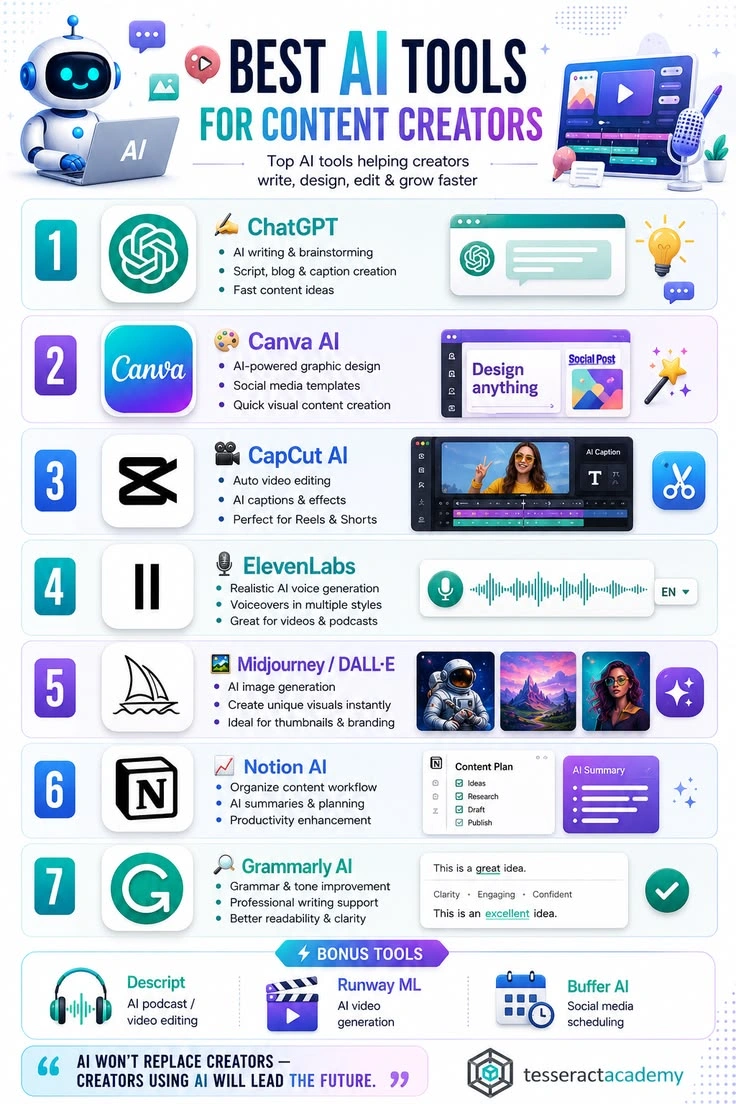
Artificial Intelligence has democratized creativity and education, making powerful tools accessible to beginners without requiring advanced technical skills. In 2026, AI tools have become essential companions for content creators, students, professionals, and lifelong learners. These tools can generate ideas, write drafts, create visuals, explain complex concepts, and personalize learning experiences. For beginners, the key is choosing user-friendly platforms that balance ease of use with meaningful output.
This guide explores the best AI tools for content creation and learning, offering practical insights on how to use them effectively while building essential skills.
AI Tools for Content Creation
Content creation has become significantly easier with AI assistance. Beginners can now produce professional-quality material with minimal experience.
Writing and Text Generation Tools
Modern AI writing assistants excel at generating blog posts, social media captions, emails, and scripts. They help overcome writer’s block by suggesting outlines, headlines, and full drafts. For beginners, these tools are excellent for learning structure and tone. Start with simple prompts like “Write a 300-word introduction to healthy eating for beginners” and gradually refine outputs by providing more specific instructions.
Image and Visual Creation Tools
AI image generators allow beginners to create stunning visuals, thumbnails, infographics, and social media graphics without design skills. These tools understand natural language descriptions and produce high-quality images in seconds. Beginners should experiment with detailed prompts, such as style references (e.g., “in the style of minimalist illustration”) to achieve better results. These visuals can dramatically improve content engagement on platforms like Instagram, YouTube, and blogs.
Video and Audio Editing Tools
AI-powered video editors can automatically generate captions, remove background noise, suggest cuts, and even create short clips from longer footage. For audio, text-to-speech tools help create voiceovers, podcasts, and narration with natural-sounding voices in multiple languages. Beginners can produce simple explainer videos or podcast episodes by combining AI writing with AI voice generation.
AI Tools for Learning and Skill Development
AI is revolutionizing how people acquire knowledge, making education more personalized and accessible.
Personalized Learning Assistants
AI tutors adapt to individual learning styles, pace, and knowledge gaps. They can explain concepts in simple terms, create practice quizzes, and track progress over time. For beginners learning new subjects like programming, digital marketing, or languages, these tools provide patient, 24/7 support that traditional classrooms often cannot match.
Research and Knowledge Tools
AI research assistants help beginners quickly understand complex topics by summarizing research papers, articles, and books. They can answer follow-up questions and suggest related concepts to explore. This capability is particularly useful for students and professionals who need to grasp new domains efficiently.
Skill-Building Platforms
Many platforms now incorporate AI to create customized learning paths. They recommend courses, generate practice exercises, and provide instant feedback on assignments. Beginners can learn coding, design, writing, or public speaking with AI coaches that adjust difficulty levels based on performance.
How to Choose the Right AI Tools
For beginners, consider these factors when selecting tools:
-
Ease of Use: Choose platforms with intuitive interfaces and helpful onboarding tutorials.
-
Free Tier Availability: Start with tools offering generous free plans to experiment without financial commitment.
-
Output Quality: Test multiple tools with the same prompt to compare results.
-
Privacy and Safety: Prefer tools with clear data policies, especially when working with personal or sensitive content.
-
Learning Curve: Select tools that help you improve your own skills rather than completely replacing your input.
Best Practices for Beginners Using AI Tools
Start Simple: Begin with basic prompts and gradually add complexity as you become comfortable. For example, start with “Explain photosynthesis simply” before moving to “Create a 500-word article on photosynthesis for high school students.”
Always Edit and Customize: AI outputs should be viewed as drafts. Review everything for accuracy, originality, and personal voice. Add your insights, experiences, and unique perspective to make the content authentic.
Combine Tools Strategically: Use different AI tools for different purposes. One for research, another for writing, and a third for visuals. This creates a powerful workflow that enhances productivity.
Focus on Learning: Treat AI as a teacher rather than a replacement. Analyze how the tool structures content, explains concepts, or generates ideas. This approach helps you develop your own skills over time.
Maintain Ethical Standards: Always disclose AI assistance when required, respect copyright, and avoid using AI to create misleading content. Responsible usage builds long-term credibility.
Overcoming Common Challenges
Many beginners face issues like generic outputs, hallucinations (incorrect information), or creative blocks. The solution lies in learning prompt engineering — the art of writing clear, specific instructions. Good prompts include context, desired tone, format, and examples. Practice regularly to improve results significantly.
Another challenge is over-reliance on AI. Balance tool usage with your own thinking and creativity. The goal should be augmentation, not replacement, of human effort.
The Future of AI in Content and Learning
As AI technology advances, tools will become even more sophisticated, offering deeper personalization and better understanding of user intent. Beginners who start using these tools now will be better prepared for a future where AI literacy becomes as important as traditional skills.
The combination of human creativity and AI efficiency creates unprecedented opportunities for expression and learning. By embracing these tools thoughtfully, beginners can accelerate their growth, produce higher quality work, and explore creative possibilities that were previously out of reach.
Getting Started Today
Begin your AI journey with one or two tools that match your immediate needs. Dedicate time each week to experiment, learn prompt techniques, and review outputs critically. Join online communities where beginners share experiences and tips. Track your progress and celebrate small improvements in your content quality and learning speed.
Artificial Intelligence is not here to replace human creators and learners — it is here to empower them. By approaching these tools with curiosity, responsibility, and continuous learning, beginners can unlock remarkable potential in content creation and personal development.
The future belongs to those who can effectively collaborate with AI. Start small, stay consistent, and watch your capabilities expand in ways you never imagined possible. Your journey with AI tools begins with your next prompt — make it count.
Read more – virobuzz.com
 Martin