
Months after the Congress joined hands with C. Joseph Vijay’s Tamilaga Vettri Kazhagam to form the government in Tamil Nadu, the Dravida Munnetra Kazhagam has been sending mixed signals on Leader of the Opposition Rahul Gandhi’s campaign against the Election Commission. While one section of the party has sharpened its criticism of Gandhi, another has publicly defended his right to protest. The contrasting statements highlight both the changed political equations in the state and the complexities of opposition coordination at the national level.
The Protest That Triggered the Exchange
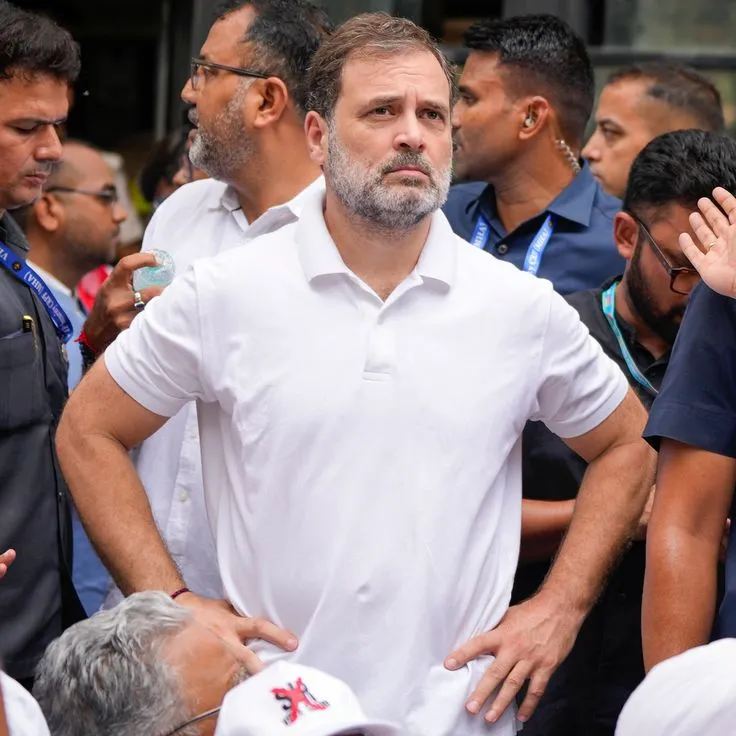
On 6 October 2026, Rahul Gandhi and other opposition MPs attempted to march to the Election Commission office in Delhi demanding the resignation of Chief Election Commissioner Gyanesh Kumar. Police stopped the procession, after which Gandhi and several colleagues staged a prolonged sit-in. The opposition has accused the CEC of enabling decisions that undermined the integrity of the electoral process, particularly in connection with the Special Intensive Revision of electoral rolls.
The protest formed part of a broader opposition campaign questioning the fairness of recent electoral exercises and calling for greater transparency and institutional accountability.
Annadurai’s Sharp Critique
Even as the protest unfolded in Delhi, DMK spokesperson Saravanan Annadurai questioned Gandhi’s consistency. In a strongly worded social media post, he asked what Gandhi’s stand was on the large-scale deletions of voters through the SIR process in Tamil Nadu. Annadurai pointed out that the Congress leader had raised forceful allegations of electoral manipulation in other contexts but had remained relatively silent on the Tamil Nadu numbers.
He further asked why Gandhi was not endorsing Congress president Mallikarjun Kharge’s reported position that state governments elected after the SIR exercise should be dissolved. Annadurai suggested that Gandhi’s reticence might stem from reluctance to criticise developments linked to the Vijay-led government, which the Congress supports. The tone of the remarks was markedly hostile, reflecting the bitterness that has entered the once-close relationship between the DMK and the Congress.
Elangovan’s Defence of the Protest
A day later, senior DMK leader TKS Elangovan struck a different note. He defended Gandhi’s right to protest, stating that citizens have the right to challenge what they see as governmental wrongdoing. Elangovan argued that elections cannot be considered fair if the person holding the highest office in the Election Commission is perceived as acting in an anti-democratic manner. He called for the CEC’s removal and accused the central government of trying to prevent Gandhi from raising the issue.
Elangovan’s comments framed the protest as a legitimate exercise of democratic rights rather than a partisan attack. The contrast with Annadurai’s earlier remarks was unmistakable and quickly noted across the political spectrum.
The Backdrop of a Broken Alliance
The mixed messaging cannot be separated from the dramatic realignment in Tamil Nadu politics. After the 2026 assembly elections, the DMK lost power following a single term. The Congress, a long-time ally, chose to support Vijay’s TVK in forming the new government. The decision effectively ended decades of partnership between the DMK and the Congress in the state and led the DMK to distance itself from the broader INDIA bloc coordination.
In this new equation, the DMK finds itself in opposition both at the Centre and in Tamil Nadu, while the Congress is part of the ruling arrangement in Chennai. Criticism of electoral processes in the state therefore carries different implications for each party. For the DMK, highlighting voter deletions can serve as a way to question the legitimacy of the current state government. For the Congress, the same issue is politically sensitive because of its support for that government.
Strategic Calculations at Play
The dual track visible in the DMK’s statements appears to serve distinct purposes. Annadurai’s attack keeps pressure on the Congress and underscores the DMK’s grievance over the alliance shift. It also signals to the party’s core supporters that the leadership has not forgotten the perceived betrayal. At the same time, Elangovan’s defence of the right to protest allows the DMK to remain broadly aligned with the national opposition’s critique of the Election Commission without fully endorsing Gandhi’s leadership of that campaign.
This calibrated approach reflects the difficulty of navigating simultaneous roles: as a former ally nursing wounds, as a state opposition party, and as a national player still interested in opposing the central government on institutional issues.
Broader Opposition Dynamics
The episode also illustrates the challenges facing opposition coordination. While parties may share concerns about the Election Commission’s functioning, their state-level interests and recent electoral experiences shape how far they are willing to go in joint campaigns. The DMK’s absence from certain INDIA bloc meetings and its selective engagement on the SIR issue show that national messaging does not always override regional political realities.
Gandhi’s decision to lead a high-visibility protest has forced other parties to clarify their positions. Some have offered full support. Others, like the DMK, have chosen a more nuanced and, at times, contradictory response.
A Relationship Still in Flux
The hot-and-cold posture towards Rahul Gandhi reveals a relationship that remains unsettled. The DMK is unwilling to offer unqualified backing to a leader whose party displaced it from power in Tamil Nadu with the help of a new political force. Yet it is also reluctant to appear completely opposed to a campaign that questions the fairness of electoral institutions, an issue that resonates with its own base.
As the debate over the Election Commission and the SIR process continues, the DMK’s internal variations in tone are likely to persist. They serve as a reminder that in Indian politics, alliances and antagonisms are rarely absolute. They shift with electoral outcomes, state-level calculations and the evolving balance of power—both in Delhi and in Chennai.
Read more – thebnssection.com
 admin
admin