
The Department of Atomic Energy has informed Parliament that the land required for 220-megawatt electric small nuclear reactor units could be reduced to less than a third of current norms, subject to radiological impact assessment. The statement comes as India evaluates ways to make nuclear projects more land-efficient while opening the sector to greater private participation, including through Bharat Small Reactors.
Current Land Norms and the Proposed Reduction
According to the Department of Atomic Energy, the present typical land requirement for a twin unit of 220 MW Pressurised Heavy Water Reactors is about 330 hectares. Officials have indicated that the possibility of bringing this down to around 90 hectares is under evaluation. Any such reduction would depend on a site-specific radiological impact assessment to ensure safety standards continue to be met.
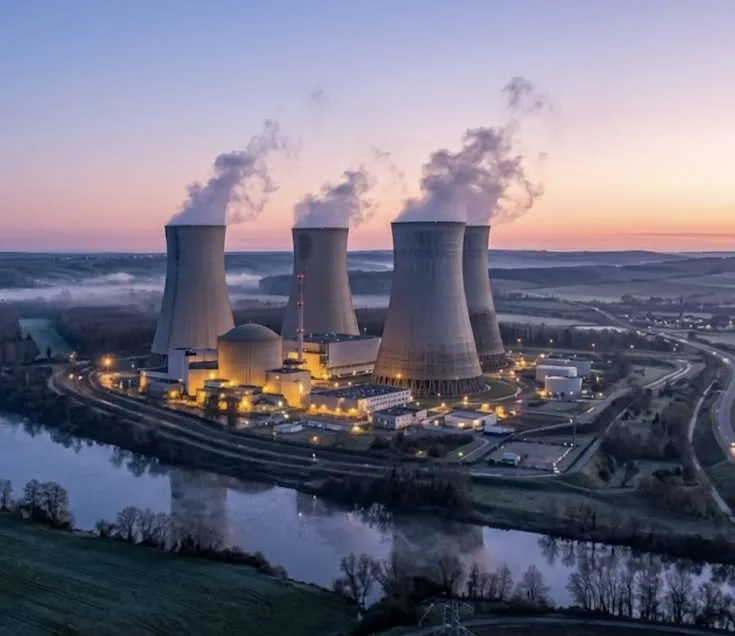
The bulk of land at nuclear sites is shaped by the exclusion zone—an area around the reactors where public habitation and certain economic activities are not permitted. Under existing practice, this zone has generally extended to a radius of about one kilometre from the reactors. Proposals under consideration would allow a smaller exclusion zone for the 220 MWe class of reactors, potentially around 500 metres, with a corresponding adjustment for larger 700 MWe units. These ideas have already been examined from safety and security perspectives by the Atomic Energy Regulatory Board and the Department of Atomic Energy and have received in-principle agreement. Final distances would still be determined by detailed radiological assessment at each location.
Why Land Efficiency Matters
Nuclear power plants have traditionally required substantial contiguous land, both for the plant buildings themselves and for the controlled exclusion area. In a densely populated country where land acquisition is often complex and time-consuming, the size of the footprint directly affects project feasibility, cost and public acceptance. Reducing the land envelope for smaller reactors could make it easier to site new capacity, particularly for captive industrial use or at locations where large parcels are difficult to assemble.
Smaller land requirements would also improve the economics of adding capacity at existing nuclear sites by allowing more generation within a given boundary. For private industrial players exploring nuclear power for their own electricity needs, a more compact footprint lowers one of the practical barriers to participation.
Bharat Small Reactors and Private Interest
Alongside the discussion on land norms, the government has been advancing the Bharat Small Reactor programme. These 220 MWe units are described as an upgraded version of the already operating Pressurised Heavy Water Reactors of the same capacity class, which have a proven safety and operational record and are considered commercially mature.
The Nuclear Power Corporation of India Limited issued a request for proposals for setting up such reactors, primarily aimed at industries with large, steady demand for clean electricity for captive consumption. Under the contemplated model, the industrial partner would provide land and cooling water, fund the capital and operating costs, and receive the power output, while NPCIL would handle design, quality assurance, construction supervision, and operation and maintenance for a fee.
Initial interest was broad. Delegates from numerous industries attended pre-proposal meetings, and several major companies completed preliminary formalities or sought project documentation. Ultimately, however, only Hindalco Industries submitted a formal proposal. Discussions between the company and NPCIL are continuing to finalise project details, including the number of reactors, which would depend on the sites the industrial partner can make available.
Linking Land Policy and Private Participation
The evaluation of reduced land requirements and the progress of the Bharat Small Reactor programme are connected. Compact siting makes captive nuclear projects more practical for energy-intensive industries such as metals, which need reliable, low-carbon baseload power. A smaller exclusion zone, if approved after rigorous assessment, would strengthen the case for locating reactors closer to industrial clusters or within existing industrial zones, provided all safety and environmental criteria are satisfied.
The Department of Atomic Energy’s parliamentary reply underscores that any reduction remains conditional. Radiological impact assessment is not a formality; it is the technical process that determines whether a smaller controlled area can still keep public radiation exposure within prescribed limits under both normal operation and postulated accident conditions. Safety and security considerations remain paramount.
Broader Context of Nuclear Expansion
India has set ambitious long-term targets for nuclear capacity as part of its clean-energy strategy. Achieving those targets will require both large reactors at conventional sites and smaller units that can serve industrial and potentially other specialised needs. Land availability has long been recognised as one of the constraints. The current evaluation of more compact layouts for 220 MWe units is therefore a practical response to that constraint, provided it does not compromise the regulatory standards that govern nuclear siting.
Private participation, still at an early stage, will test whether industrial users are prepared to invest in nuclear assets under the framework being developed. Hindalco’s position as the sole formal proposer so far indicates both interest and caution among potential participants. The outcome of ongoing discussions, together with clarity on revised land and exclusion-zone norms, will influence how many other companies eventually step forward.
Safety First, Flexibility Second
The government’s message is carefully balanced. On one hand, it is exploring significant reductions in land use for smaller reactors—from roughly 330 hectares to as little as 90 hectares for a twin 220 MWe station—subject to technical validation. On the other, it insists that any change must rest on radiological impact assessment and the existing safety philosophy. Parallel progress on Bharat Small Reactors shows an attempt to create a pathway for private capital and captive demand without altering the fundamental responsibility for nuclear design, construction quality and operations, which remains with the established public-sector operator.
If the reduced land norms are ultimately approved and the first captive small-reactor projects move forward, India will have taken a concrete step toward making nuclear power more adaptable to industrial needs and less constrained by the traditional large-site model. The parliamentary statement marks an important clarification of that direction, while leaving the final technical judgements where they belong—with the safety regulators and site-specific assessments.
Read more – laicaicai.com