
Pancreatic cancer has long been one of the most formidable challenges in oncology, known for its aggressive nature, late diagnosis, and limited treatment options. With a five-year survival rate historically below 10-12%, advances in this field have been painfully slow. However, at the 2026 American Society of Clinical Oncology (ASCO) Annual Meeting, Dr. Shubham Pant, an Indian-origin oncologist at The University of Texas MD Anderson Cancer Center, presented groundbreaking results that have generated significant optimism. The phase 3 RASolute 302 trial demonstrated that the novel oral drug daraxonrasib nearly doubled overall survival in patients with previously treated metastatic pancreatic ductal adenocarcinoma (mPDAC) compared to standard chemotherapy.
This achievement represents one of the most meaningful improvements in pancreatic cancer treatment in over a decade and signals a potential paradigm shift in managing this deadly disease.
Understanding the Breakthrough
Daraxonrasib is a multi-selective RAS(ON) inhibitor designed to target the RAS family of mutations, which drive approximately 90-95% of pancreatic cancers. In the RASolute 302 trial, 500 patients with previously treated metastatic pancreatic cancer were randomized to receive either daraxonrasib or investigator’s choice chemotherapy.
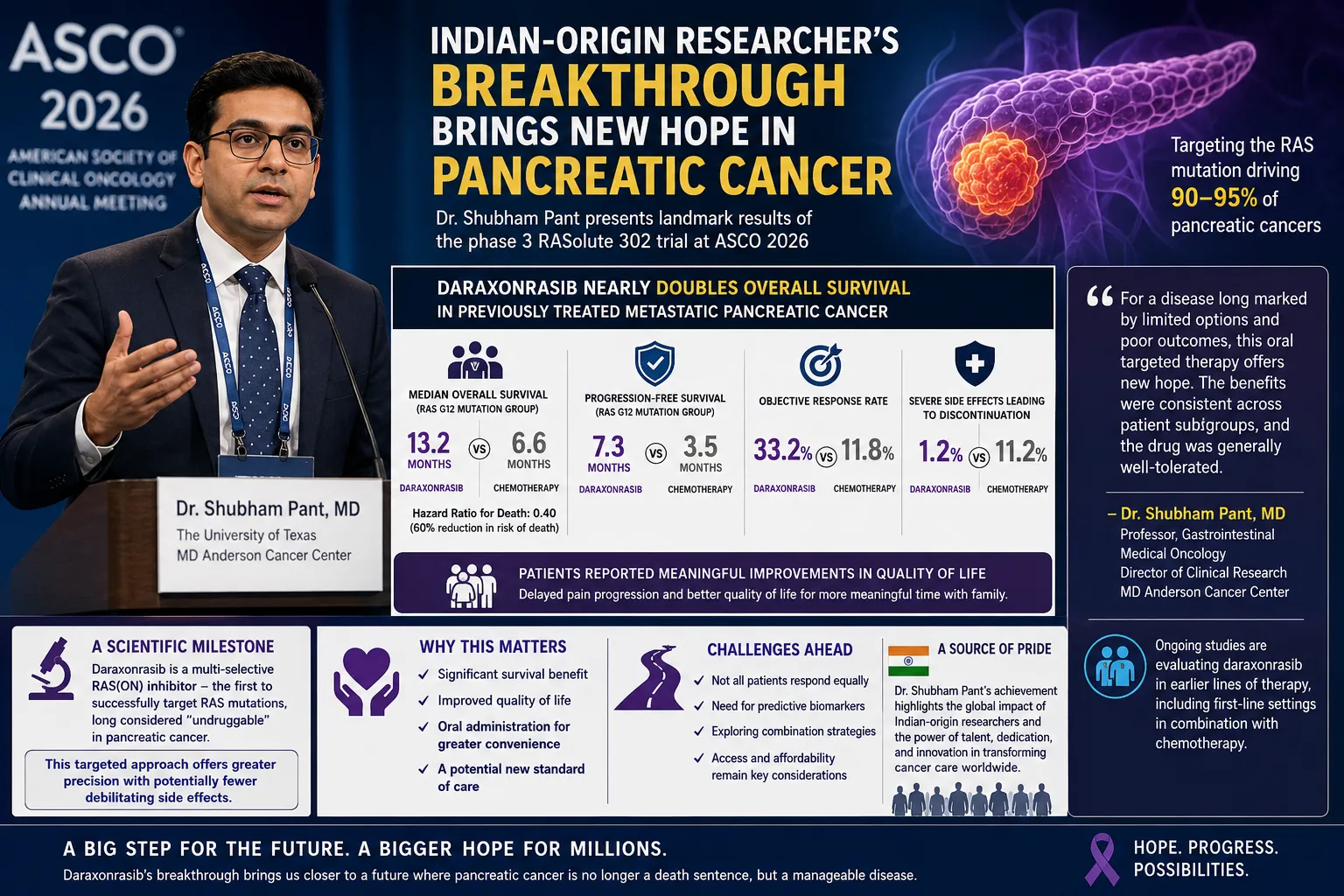
The results were striking. In the primary analysis population (patients with RAS G12 mutations, comprising over 91% of participants), median overall survival reached 13.2 months with daraxonrasib compared to 6.6 months with chemotherapy — effectively doubling survival time. The hazard ratio for death was 0.40, indicating a 60% reduction in the risk of death. Similar benefits were observed in the overall study population.
Progression-free survival also improved dramatically: 7.3 months versus 3.5 months in the RAS G12 group. Objective response rates were nearly three times higher with the new drug (33.2% vs 11.8%). Importantly, daraxonrasib showed a more favorable safety profile, with fewer severe side effects leading to treatment discontinuation (1.2% vs 11.2% in the chemotherapy arm).
Beyond survival metrics, patients reported meaningful improvements in quality of life. The time to pain deterioration was significantly delayed, and overall quality of life was maintained for longer periods, allowing patients to spend more meaningful time with family and engage in daily activities.
Dr. Shubham Pant’s Perspective
Dr. Pant, who played a key role in the trial, described the results as “historic” and potentially practice-changing. As a professor in Gastrointestinal Medical Oncology and Director of Clinical Research at MD Anderson, he emphasized that for a disease long marked by limited options and poor outcomes, this oral targeted therapy offers new hope. He highlighted that the benefits were consistent across different patient subgroups and that the drug was generally well-tolerated.
Dr. Pant noted that while the current data is for second-line treatment (after initial chemotherapy), ongoing studies are evaluating daraxonrasib in earlier lines of therapy, including first-line settings in combination with chemotherapy. These larger trials will be crucial in determining whether the drug can be moved forward in the treatment sequence for even greater impact.
Why This Matters for Pancreatic Cancer
Pancreatic cancer is notoriously difficult to treat because of its biology. The RAS mutations that drive most cases were long considered “undruggable.” Daraxonrasib’s success in targeting these mutations directly represents a major scientific milestone. Unlike traditional chemotherapy, which attacks rapidly dividing cells indiscriminately, this targeted approach offers greater precision with potentially fewer debilitating side effects.
The implications extend beyond survival numbers. For patients and families, gaining additional months or even years of quality time is profoundly meaningful. The oral administration also improves convenience compared to intravenous chemotherapy, reducing the burden of frequent hospital visits.
Challenges and the Road Ahead
While these results are encouraging, experts caution that more work remains. Pancreatic cancer still has a high mortality rate, and not all patients respond equally. Researchers are investigating biomarkers that could help identify those most likely to benefit. Combination strategies and earlier intervention are active areas of study.
Access and affordability will also be important considerations as the drug moves toward broader approval and availability. Continued collaboration between researchers, pharmaceutical companies, regulatory bodies, and patient advocacy groups will be essential to translate this breakthrough into real-world benefits.
A Source of Pride for the Indian Diaspora
Dr. Shubham Pant’s contribution highlights the growing impact of Indian-origin researchers in global oncology. His work exemplifies how talent from India continues to shape medical progress worldwide, bringing both scientific excellence and cultural sensitivity to patient care.
For the millions affected by pancreatic cancer globally — including a significant number in India — this breakthrough brings renewed hope. It underscores the importance of sustained investment in cancer research and the power of international clinical trials in advancing treatments.
Final Thoughts
The results presented by Dr. Shubham Pant at ASCO 2026 mark a significant milestone in the long battle against pancreatic cancer. Daraxonrasib’s ability to nearly double survival while improving quality of life represents a big step forward — not just in extending life, but in restoring hope and dignity to patients facing this challenging diagnosis.
As larger studies explore its potential in earlier treatment settings, the oncology community remains cautiously optimistic. For now, this Indian-origin researcher’s work stands as a beacon of progress in a field that has seen too few victories.
The journey toward better outcomes in pancreatic cancer is far from over, but breakthroughs like daraxonrasib remind us that persistence, innovation, and global collaboration can gradually turn the tide against even the most formidable diseases. For patients, families, and the medical community, this is more than just data — it is a meaningful step toward a brighter future.
 Martin