
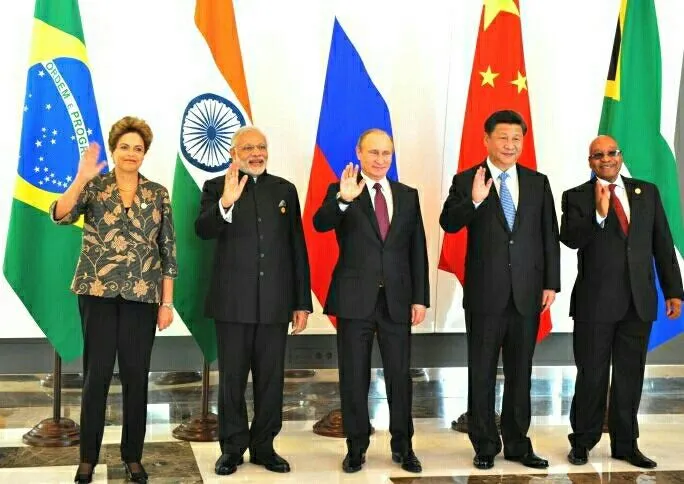
As India hosts the BRICS summit in New Delhi, a familiar narrative has resurfaced: that the grouping is an anti-Western coalition bent on overturning the US-led international order. The reality is more complex. BRICS members pursue a range of national aims—accommodation with the West, autonomy from it, parity within it, or, in some cases, more direct confrontation. Treating the forum as a single, coherent anti-West bloc obscures these differences and misunderstands both its origins and its current dynamics.
Diverse Ambitions Within One Grouping
BRICS brings together countries with sharply different relationships to the existing international system. Russia, facing extensive Western sanctions and exclusion from key financial mechanisms, has strong incentives to treat the grouping as a counterweight and an alternative economic lifeline. China, while deeply integrated into the global economy, sees value in platforms that dilute American institutional dominance and expand its own influence across the Global South. Iran, under heavy pressure from the United States and its partners, finds natural alignment with efforts to reduce Western leverage.
Other members approach the forum differently. India has consistently framed BRICS as a non-Western rather than anti-Western platform. It seeks greater voice for developing countries, reform of international financial institutions, and strategic autonomy that allows simultaneous engagement with the United States, Europe, Russia, China and others. Brazil has often emphasised economic cooperation and institutional reform over geopolitical confrontation. Newer members such as the United Arab Emirates maintain close security and economic ties with the West even as they participate in BRICS. South Africa and others view the grouping as one more avenue for development finance and diplomatic diversification rather than a vehicle for systemic overthrow.
These differences mean that consensus on overtly confrontational language or strategies is difficult. What unites the members more reliably is a shared dissatisfaction with aspects of the current order—particularly the perceived under-representation of developing economies in global decision-making—and a desire for greater policy space.
India’s Dual Challenge as Host
India’s presidency places it at the centre of this complexity. Its challenge is twofold. First, it must articulate the forum’s common interest in democratising the international system—making institutions more representative and responsive to the needs of a larger share of the world’s population and economic activity. Second, it must counter the widespread impression, encouraged by both some BRICS enthusiasts and many Western critics, that the grouping’s primary purpose is to dismantle or replace the US-led order.
New Delhi has long argued that multipolarity and institutional reform need not equal hostility. India’s own foreign policy practice—participation in the Quad alongside the United States, Japan and Australia, deep economic and technology ties with Europe and America, continued engagement with Russia, and management of a difficult relationship with China—illustrates a preference for multi-alignment over bloc politics. For India, BRICS is useful precisely because it is not a military alliance or an ideological caucus. It is a forum in which diverse powers can coordinate on select issues without demanding uniformity on all strategic questions.
Non-Western Versus Anti-Western
The distinction between “non-Western” and “anti-Western” is central. A non-Western orientation seeks space for different political systems, development models and civilisational perspectives within a reformed global architecture. An anti-Western project defines itself primarily by opposition to the United States and its allies. BRICS contains elements of both impulses, but the balance varies by member and by issue.
Calls for greater use of local currencies in trade, criticism of unilateral sanctions, and advocacy for reform of the IMF and World Bank reflect a desire to reduce asymmetric dependence and increase resilience. They do not automatically equate to a coordinated strategy to destroy existing institutions. Many BRICS countries continue to benefit from trade, investment, technology and security relationships with Western partners. Overturning the system wholesale would carry costs that several members are unwilling to bear.
Expansion has further complicated any simple characterisation. Adding countries with varied strategic orientations has increased the grouping’s demographic and economic weight, but it has also multiplied internal divergences. Reaching consensus on sensitive geopolitical language has become harder, as seen in earlier ministerial meetings that struggled to produce joint statements on contested regional conflicts.
Practical Cooperation Amid Strategic Differences
Despite these tensions, BRICS continues to function as a platform for practical cooperation. Discussions on development finance, infrastructure, technology, energy and resilient supply chains reflect areas where interests overlap even when broader strategic visions differ. The New Development Bank and various working groups provide concrete mechanisms that do not require members to agree on the future of the global order.
India’s presidency has sought to emphasise themes of resilience, innovation, cooperation and sustainability, steering the agenda toward developmental and economic priorities rather than pure geopolitical signalling. This approach aligns with the preferences of members who want the forum to remain useful for tangible outcomes rather than becoming a stage for confrontational rhetoric.
Implications for the International System
The persistence of BRICS does not prove the emergence of a unified anti-Western bloc. It does indicate that a significant portion of the world’s population and economic activity seeks greater agency in global governance. Ignoring that demand or reducing it to hostility risks misreading the motivations of countries that want reform and diversification rather than rupture.
For Western policymakers, the more productive response is to take seriously the underlying grievances about representation and fairness while recognising that many BRICS members remain open to engagement. For BRICS members themselves, the test is whether the grouping can deliver enough practical value to justify the diplomatic effort required to manage its internal diversity.
A More Accurate Frame
Putting all of BRICS into an anti-West box flattens important differences and misunderstands the strategic calculations of key members. Some participants do view the current order as fundamentally inequitable and seek to constrain Western power. Others want a larger seat at the table, more policy autonomy, and alternatives that reduce vulnerability—without abandoning beneficial relationships with the United States and Europe.
India’s task during the Delhi summit is to keep the emphasis on the shared, reformist agenda while preventing the forum from being defined solely by its most confrontational voices. Success will be measured not by the strength of anti-Western language in the outcome documents, but by whether BRICS continues to function as a flexible platform for a diverse set of rising and established powers seeking greater influence in a changing world. In that sense, the grouping’s complexity is not a weakness to be papered over; it is the clearest evidence that it cannot be reduced to a single geopolitical slogan.
Read more – SmallBizSeo.org