
Creating a high-quality article requires more than good writing skills. The foundation of any valuable article is strong research. Well-researched content helps writers present accurate information, build credibility, and provide real value to readers. In today’s digital environment, readers expect content that is informative, reliable, and supported by facts.
Effective research ensures that an article is not only engaging but also trustworthy. Writers who invest time in researching their topics can create content that answers questions clearly, supports arguments with evidence, and improves search engine visibility. By using proper research methods, writers can produce articles that stand out in a competitive online space.
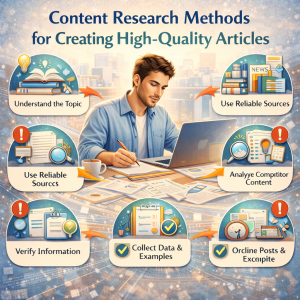
Below are some of the most effective content research methods that help writers create professional and high-quality articles.
Table of Contents
ToggleUnderstanding the Topic Before Writing
Before beginning any article, it is essential to develop a clear understanding of the topic. Writers should start by identifying the key concepts, main issues, and important questions related to the subject. This initial stage helps build a strong foundation for the entire article.
Understanding the topic also helps writers avoid misinformation and confusion. Reading multiple reliable materials and analyzing how different experts discuss the topic provides valuable context. When writers fully understand a topic, they can explain it more clearly and present ideas in a structured and logical manner.
Using Authoritative and Reliable Sources
One of the most important research methods is relying on credible and authoritative sources. Reliable information can be found in academic journals, government publications, industry reports, and well-established news organizations. These sources usually follow strict editorial standards, which makes the information trustworthy.
Using credible sources strengthens the quality of an article and improves the writer’s reputation. Readers are more likely to trust content that is supported by reliable information. Additionally, professional writers cross-check information from multiple sources to ensure accuracy and consistency.
Analyzing Existing Articles and Competitor Content
Reviewing existing articles on the same topic is another effective research strategy. By studying well-written articles, writers can identify common themes, key statistics, and important discussions within the subject area. This method helps writers understand what information readers expect.
Analyzing competitor content also reveals content gaps. These are areas where existing articles may lack detail or clarity. Writers can improve their own articles by addressing these gaps, providing deeper insights, and presenting information in a clearer or more engaging way.
Collecting Data, Statistics, and Evidence
High-quality articles often include data, statistics, and factual evidence to support the main arguments. These elements make the content more convincing and informative. Data can come from research studies, industry reports, surveys, and official publications.
Including accurate statistics helps readers understand the scale or impact of an issue. It also adds authority to the article. However, writers must ensure that the data they use is current, relevant, and interpreted correctly to avoid misleading readers.
Organizing Research with Notes and Content Outlines
After collecting information, it is important to organize research materials properly. Writers often create notes and outlines to structure their articles effectively. This process helps identify the most important points and ensures that the article follows a logical flow.
A clear outline usually includes the introduction, main sections, and conclusion. Organizing research in this way allows writers to connect ideas smoothly and avoid repetition. It also saves time during the writing stage because all the necessary information is already arranged in a structured format.
Verifying Information and Fact-Checking
Fact-checking is a crucial step in professional content writing. Even reliable sources can occasionally contain outdated or incomplete information. Therefore, writers should verify key facts by comparing them with multiple trustworthy sources.
Fact-checking ensures that the article remains accurate and credible. It also prevents the spread of misinformation, which can damage the writer’s reputation and reduce reader trust. Careful verification is especially important when discussing statistics, historical facts, or technical topics.
Incorporating Expert Insights and Real-World Examples
Adding expert opinions and real-world examples can greatly enhance the quality of an article. Experts provide specialized knowledge and deeper insights into complex topics. Their perspectives help readers understand the practical implications of the subject.
Real-world examples make the content more relatable and easier to understand. They illustrate how theories or concepts apply in everyday situations. By combining expert insights with clear examples, writers can make their articles more engaging and informative.
Updating Research to Maintain Relevance
Information changes quickly, especially in fields such as technology, finance, and health. Writers should always check whether their research is up to date before publishing an article. Using outdated information can reduce the value and reliability of the content.
Regularly updating research helps writers maintain accuracy and relevance. It also ensures that readers receive the most current knowledge available. Professional writers often review their research materials carefully to confirm that the data and examples remain valid.
Conclusion
High-quality articles are built on strong and reliable research. Writers who invest time in understanding their topics, using credible sources, analyzing existing content, and verifying facts can produce informative and trustworthy articles. Effective research methods help writers present ideas clearly, support their arguments with evidence, and provide meaningful insights to readers.
In a digital world where information is abundant, quality research sets professional content apart from ordinary writing. By applying structured research techniques and maintaining a commitment to accuracy, writers can create articles that educate, engage, and build long-term credibility with their audience.
 Streamline