
SpaceX has successfully completed a wet dress rehearsal for Starship Flight 14, clearing one of the final major technical milestones before the vehicle’s first attempt to reach Earth orbit. The test, conducted on September 24, involved loading propellants into the fully stacked rocket and running through a complete launch-day sequence without igniting the engines.
What a Wet Dress Rehearsal Involves
A wet dress rehearsal is a critical pre-launch procedure in which teams fill the rocket’s tanks with cryogenic propellants—liquid methane and liquid oxygen—and execute the countdown timeline as if preparing for liftoff. Engineers monitor propellant loading rates, temperatures, pressures, valve operations, ground system performance and the interaction between the vehicle and the launch pad. The sequence typically proceeds to a simulated T-0 without engine start, after which the propellants are safely drained.
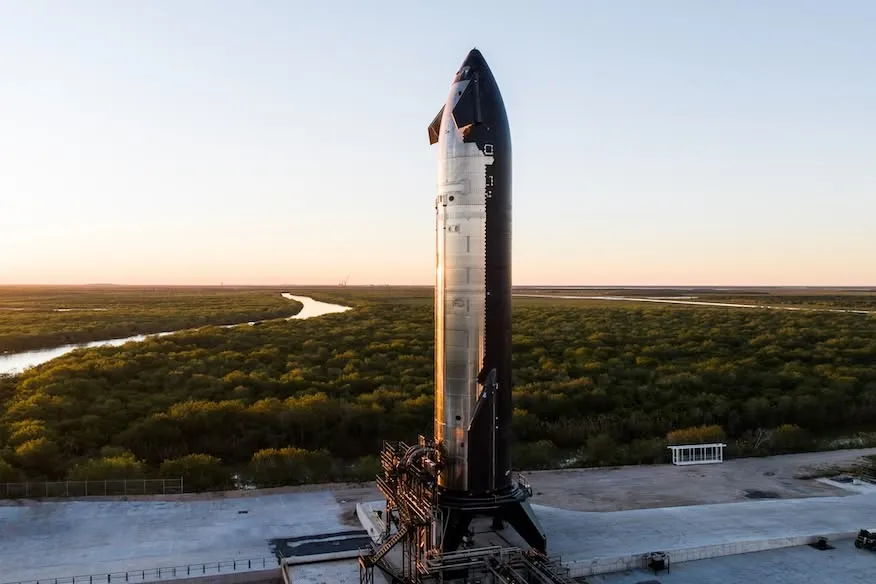
For Starship, the rehearsal verified the readiness of both the Super Heavy booster (Booster 21) and the upper-stage spacecraft (Ship 41), along with the associated ground infrastructure at the company’s Starbase facility in South Texas. SpaceX confirmed completion of the rehearsal in an official social media update, signalling that the vehicle and pad systems performed as expected.
Flight 14: The First Orbital Attempt
All 13 previous integrated Starship flights followed intentionally suborbital trajectories. These paths allowed the company to test ascent, stage separation, heat-shield performance, controlled re-entry and landing sequences while keeping the vehicle on a course that returned it to Earth within roughly an hour. Flight 14 is designed to break that pattern by placing Ship 41 into a sustained low-Earth orbit.
Current plans call for the spacecraft to reach an altitude of approximately 275 kilometres and complete about six orbits over a mission lasting nearly 10 hours. After orbital insertion, Ship 41 is expected to deploy a payload of 26 Starlink Version 3 satellites—the first operational Starlink deployment from a Starship vehicle. Later in the flight, a single Raptor engine is scheduled to perform a deorbit burn, followed by a controlled atmospheric re-entry and splashdown in the Pacific Ocean west of Chile. The Super Heavy booster is targeted for a controlled splashdown in the Gulf of Mexico.
The full stack stands roughly 407 feet tall, making it the largest and most powerful rocket ever flown. Liftoff is currently targeted for September 28 during a 75-minute launch window that opens in the early morning hours local time at Starbase, pending final regulatory approval.
Technical Progress and Remaining Steps
The wet dress rehearsal follows earlier static-fire tests of Ship 41’s engines and progressive improvements to both the vehicle hardware and ground systems. Modifications on the booster side include enhanced propellant filtering and software updates aimed at improving engine relight reliability. The upper stage carries refined heat-shield tiles and control systems refined through the previous flight-test campaign.
One key remaining requirement is a launch licence from the Federal Aviation Administration. SpaceX has indicated that the September 28 target remains subject to receipt of that approval and completion of any final close-out work at the pad. Weather and range conditions will also factor into the final go/no-go decision.
Broader Significance for Starship Development
Reaching orbit represents a fundamental step change for the Starship programme. Sustained orbital flight enables testing of longer-duration systems, precise orbital manoeuvres, payload deployment operations and the thermal and structural loads associated with returning from orbital velocity. Success would also demonstrate the vehicle’s ability to serve as a high-capacity satellite launcher while continuing to mature the technologies needed for rapid reuse.
SpaceX’s long-term vision for Starship centres on full and rapid reusability of both stages, eventually supporting crewed missions to the Moon and Mars as well as high-volume cargo delivery. The current flight-test series is structured to retire risk incrementally. Each successive mission has expanded the envelope—first proving controlled flight, then heat-shield durability, then booster catch attempts and now the transition to orbital operations.
Looking Ahead
With the wet dress rehearsal complete, attention turns to final preparations and the regulatory process. If Flight 14 proceeds as planned, it will mark the first time a Starship upper stage has remained in space long enough to circle the planet multiple times and the first time the system has delivered functional satellites to orbit.
The outcome will provide valuable data on orbital insertion accuracy, satellite deployment mechanisms, in-space engine restart performance and the behaviour of the thermal protection system during a higher-energy re-entry. Regardless of the precise results, the mission will supply engineers with a new set of flight data to refine designs and procedures for subsequent vehicles.
Starship Flight 14 therefore stands as more than a routine test. It is the point at which the programme moves from suborbital experimentation into the operational regime of orbital flight—an essential threshold on the path toward the fully reusable transportation system SpaceX is working to build. The successful completion of the wet dress rehearsal has brought that milestone one measured step closer.
Read more – Dailymarathishayari.com
 Martin