
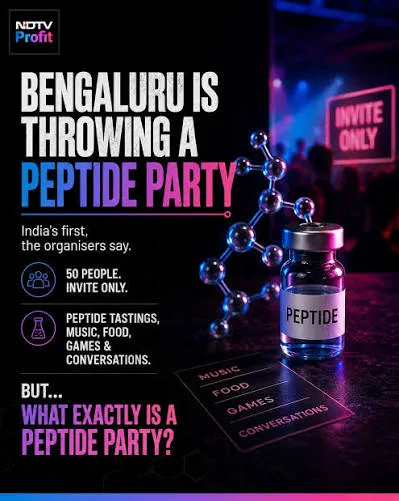
Bengaluru is preparing to host what organisers describe as India’s first “peptide party,” an invite-only gathering scheduled for August 29. The event, limited initially to about 50 participants, has already attracted more than 200 registrations and considerable online attention. Alongside curiosity about the format, it has also drawn criticism from doctors and observers concerned about the promotion of substances whose benefits and risks remain incompletely understood.
What the Event Involves
The gathering is being hosted by Anushka Singh, associated with Upsurge Labs, in collaboration with Peptide OS Labs and others, and has been listed through an events platform. Organisers have framed the evening as a relaxed introduction to peptides rather than a formal lecture. Planned elements include peptide tastings (described as oral and research-grade), music, food, games and open conversation among people interested in the topic. Hosts have emphasised that the venue is not a hospital and have responded to rapid demand by considering a larger space.
Similar gatherings focused on peptides have taken place in other countries, bringing together enthusiasts, practitioners and industry participants. In Bengaluru the combination of exclusivity, wellness language and the relatively new status of the concept in India has amplified both interest and scrutiny.
Understanding Peptides
Peptides are short chains of amino acids, the building blocks of proteins. The human body produces many of them naturally; they act as signalling molecules involved in processes ranging from hormone regulation to tissue repair. A number of peptides have long-established medical uses and are approved as prescription drugs for specific conditions.
In recent years a wider range of peptides has entered popular wellness and biohacking discussions. These compounds are often promoted for potential effects on recovery, skin appearance, body composition, energy or aspects of ageing. Celebrity mentions and social-media commentary have accelerated awareness. Some users and companies report personal or anecdotal benefits, while others market products directly to consumers online.
Why the Event Has Drawn Criticism
The controversy centres less on the idea of discussion than on the gap between enthusiastic promotion and rigorous evidence. Several medical voices have cautioned that many peptides circulating in the wellness space lack robust human clinical data for the uses being claimed. Regulatory status is another point of concern. Doctors note that a number of the substances discussed in biohacking circles are not approved as medicines or food ingredients in India, even when they are available for purchase through informal channels.
One prominent critic, hepatologist Cyriac Abby Philips, has characterised influencer-driven peptide promotion as part of a broader pattern of fringe or insufficiently evidenced claims. Other physicians have stressed the importance of distinguishing between approved pharmaceutical peptides and unregulated research compounds. Questions have also been raised about what “tasting” entails in practice and whether participants fully understand purity, dosage and potential interactions.
Some online users have tagged local authorities, citing possible legal or safety issues, although organisers maintain the event is educational and social rather than clinical. Clarity about the exact substances involved and the conditions under which they would be presented remains limited in public descriptions.
The Organisers’ Position
Hosts have acknowledged the volume of critical comments while pointing to strong registration numbers as evidence of genuine interest. They have referenced the use of certain peptides by high-profile figures in entertainment and wellness circles and noted that regulatory approval processes often lag behind research and early adoption. In their framing, the party is intended as a space for curiosity and conversation rather than a medical endorsement or commercial sales event.
This defence reflects a wider tension in contemporary wellness culture: the desire for early access to emerging tools versus the slower pace of clinical validation and regulatory oversight. Personal experimentation and community discussion can coexist with calls for stronger evidence, yet the boundary between exploration and promotion is frequently contested.
Broader Context of Biohacking Interest
Interest in peptides forms part of a larger trend toward self-directed health optimisation. Wearables, continuous glucose monitors, specialised diets and various supplements have already normalised the idea of tracking and intervening in bodily processes outside traditional clinical settings. Peptides fit into this landscape because they are often presented as more targeted than broad-spectrum supplements and closer to biological signalling than many synthetic compounds.
At the same time, the history of wellness trends shows repeated cycles of enthusiasm followed by reassessment once more data accumulate or adverse effects become better documented. Medical professionals generally advise that substances intended to alter physiology should be approached with caution, preferably under qualified supervision, and with clear understanding of both potential benefits and unknowns.
What Participants and Observers Should Consider
For those attending or following the event, several practical points emerge. First, the regulatory status of any compound matters; legality and safety are not identical to popularity or celebrity endorsement. Second, research-grade materials are not automatically equivalent to pharmaceutical-grade products intended for human use. Third, individual responses vary widely, and anecdotal reports, while interesting, do not substitute for controlled studies.
Public discussion itself can be valuable when it surfaces these distinctions rather than collapsing them. Events that bring curious people together may help demystify a complex topic, provided the conversation includes evidence, limitations and risk alongside potential upside. Equally, sustained expert scrutiny helps prevent hype from outrunning science.
Looking Ahead
The Bengaluru peptide party illustrates how quickly specialised wellness concepts can move from online discussion into real-world social formats. Whether the gathering remains a one-off curiosity or signals a wider Indian interest in peptide-related practices will depend on subsequent events, regulatory attention and the quality of information that circulates afterward.
For now, the episode underscores a familiar challenge: balancing openness to new ideas with the discipline of evidence. Peptides occupy a genuine place in medicine; many others remain experimental. Distinguishing between the two, and ensuring that enthusiasm does not obscure uncertainty, remains essential for anyone exploring this space—whether at a party, online or in consultation with a clinician.
Read more – wisdomsuvichar.com