
China has taken a quiet but significant step toward growing food beyond Earth. Aboard the Tiangong Space Station, the Shenzhou-23 crew has harvested the first batch of rice samples from a carefully controlled experiment. The work aims to achieve something never done before: continuous cultivation of two successive generations of rice entirely in orbit. The results could help answer a practical question that will shape future exploration—can humans one day produce reliable meals far from their home planet?
The Latest Harvest on Tiangong
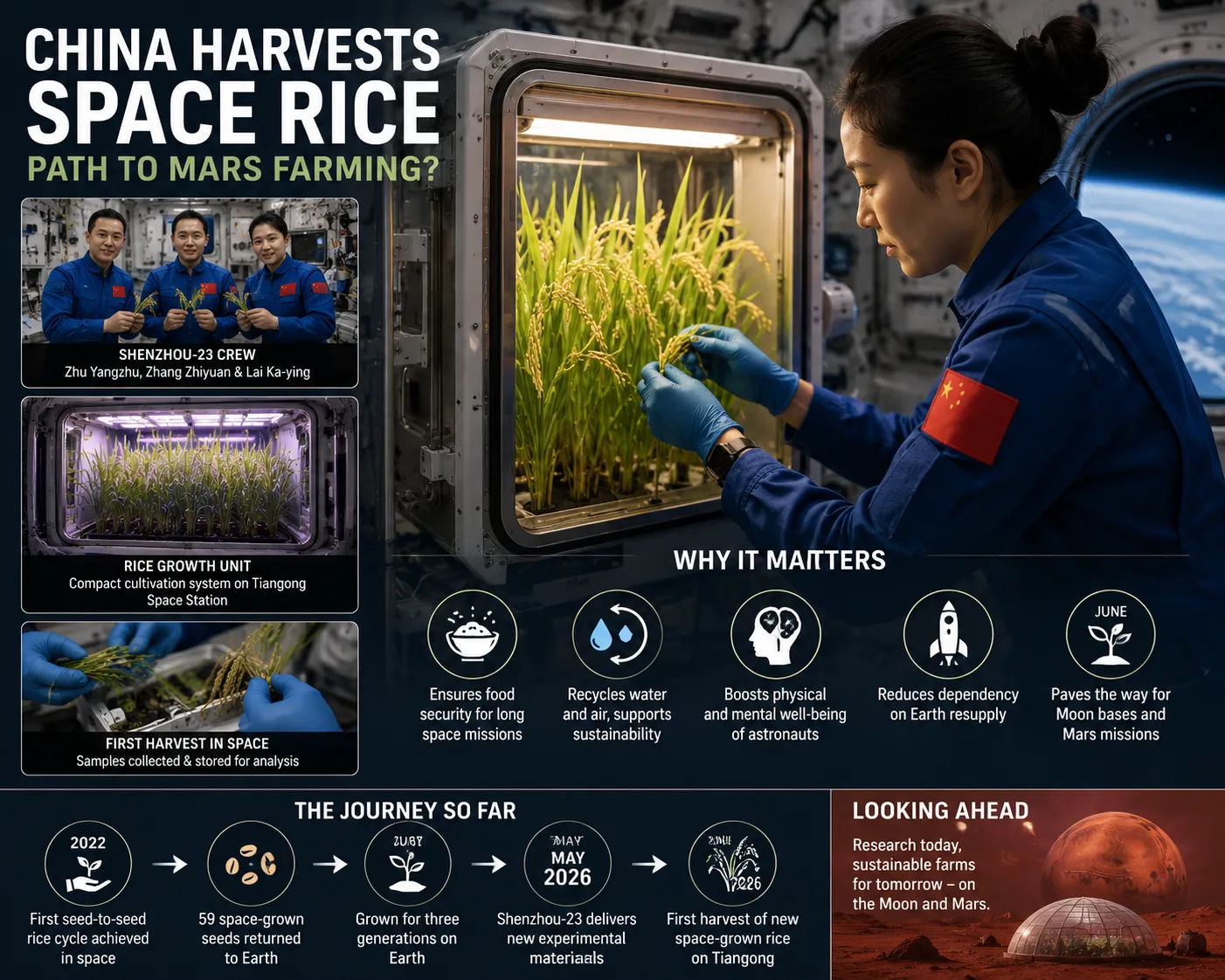
More than two months after the Shenzhou-23 spacecraft delivered fresh experimental materials in May 2026, astronauts Zhu Yangzhu, Zhang Zhiyuan and Lai Ka-ying collected and stored the first rice samples. Video released by Chinese space authorities shows the crew carefully gathering the ears and seeds inside specialised cultivation units roughly the size of a microwave oven. Some samples were placed in ultra-low-temperature storage at minus 80 degrees Celsius to preserve them for detailed analysis after return to Earth.
The experiment is formally known as a study of the molecular mechanisms of multi-generational genetic stability and environmental adaptation in space-grown rice. Its central goal is to complete two full life cycles in microgravity—from seed to seed to seed—while comparing different lineages of plants.
Building on the 2022 Breakthrough
This work continues a pioneering 2022 experiment in which Chinese researchers achieved the world’s first complete seed-to-seed rice cycle in orbit. Six seeds spent about 120 days growing, flowering and setting seed, ultimately producing 59 first-generation space-grown seeds that returned with the Shenzhou-14 crew. Those seeds were then grown for three generations on Earth.
The current mission carries two types of japonica rice, chosen for strong adaptability and a growth cycle of three to four months. One group consists of ordinary seeds that have never left Earth. The other group consists of descendants of the 2022 space harvest. By growing both side by side, scientists can examine whether prior exposure to microgravity leaves lasting effects on genetic stability or environmental response.
Why Rice, and Why Microgravity Matters
Rice feeds a large portion of the world’s population and is considered a strong candidate for space agriculture because of its nutritional value and relatively compact growth habit. Yet plants evolved under Earth’s gravity. In the near-weightless environment of orbit, roots, stems and leaves behave differently. Orientation cues disappear, water and nutrient distribution change, and gene expression related to growth and reproduction can shift.
Earlier observations showed that space-grown rice plants sometimes display altered architecture, such as looser form or different leaf angles. Some returned seeds exhibited temporary “direction confusion” when germinating on Earth. The new multi-generation experiment seeks to determine whether these effects stabilise, worsen or diminish across successive cycles. Understanding those mechanisms is essential before larger-scale food production can be planned.
The Broader Purpose of Space Farming
Growing food in space serves several overlapping goals. For short missions, resupply from Earth remains practical. For long-duration stays on the Moon or journeys to Mars, constant delivery of all food becomes extremely costly and risky. In-situ production would reduce dependence on Earth, provide fresh nutrition, recycle water and air through plant processes, and offer psychological benefits to crews living far from home.
Controlled-environment agriculture in space also tests technologies that can later improve farming on Earth—more efficient water use, compact growth systems and crops selected for resilience. Rice experiments form part of a wider international effort that has included vegetables, wheat, potatoes and other plants on various orbital platforms.
Challenges Still Ahead
Harvesting a few rice plants in a sealed module is a long way from feeding a crew. Scaling up requires reliable systems for lighting, nutrient delivery, atmosphere control, pest management and waste recycling. Genetic stability must be confirmed over many generations. Crops must deliver adequate calories, protein and micronutrients under the constraints of limited volume and power. Radiation protection and the effects of partial gravity on the Moon or Mars remain additional unknowns.
Mars presents an even harder environment than low-Earth orbit. Its thin atmosphere, extreme temperatures, dust and lower gravity would demand sophisticated greenhouses or underground habitats. Soil chemistry differs sharply from Earth’s, so any local resources would need extensive processing. Early Martian farms, if they ever exist, would likely begin as highly engineered, closed systems rather than open fields.
A Measured Step Toward Self-Sufficiency
The Tiangong rice harvest does not mean astronauts will soon dine on orbital-grown grain. It does demonstrate steady progress in mastering the basic biology of a staple crop under space conditions. By attempting two consecutive generations, Chinese researchers are gathering data that no previous mission has obtained. Those data will help refine cultivation methods, select more adaptable varieties and design better life-support systems.
Future missions will continue testing larger volumes, different crops and more automated systems. International cooperation and parallel national programmes will accelerate learning. Each successful cycle—from seed to harvest to new seed—narrows the gap between laboratory demonstration and practical food production.
Looking Toward Distant Tables
Humanity’s long-term presence beyond Earth will depend on the ability to grow food locally. The rice plants now completing their first harvest on Tiangong represent one careful, methodical contribution to that capability. They show that complex crops can complete their life cycles in microgravity and that multi-generational studies are feasible.
Whether those lessons eventually support a meal on Mars remains a question for coming decades. The science being gathered today—genetic responses, growth patterns, practical cultivation techniques—forms the necessary foundation. For now, the quiet work of astronauts tending rice in orbit marks a tangible advance: proof that the ancient human practice of farming can adapt, step by step, to environments never before cultivated.
Read more – coverexa.com