
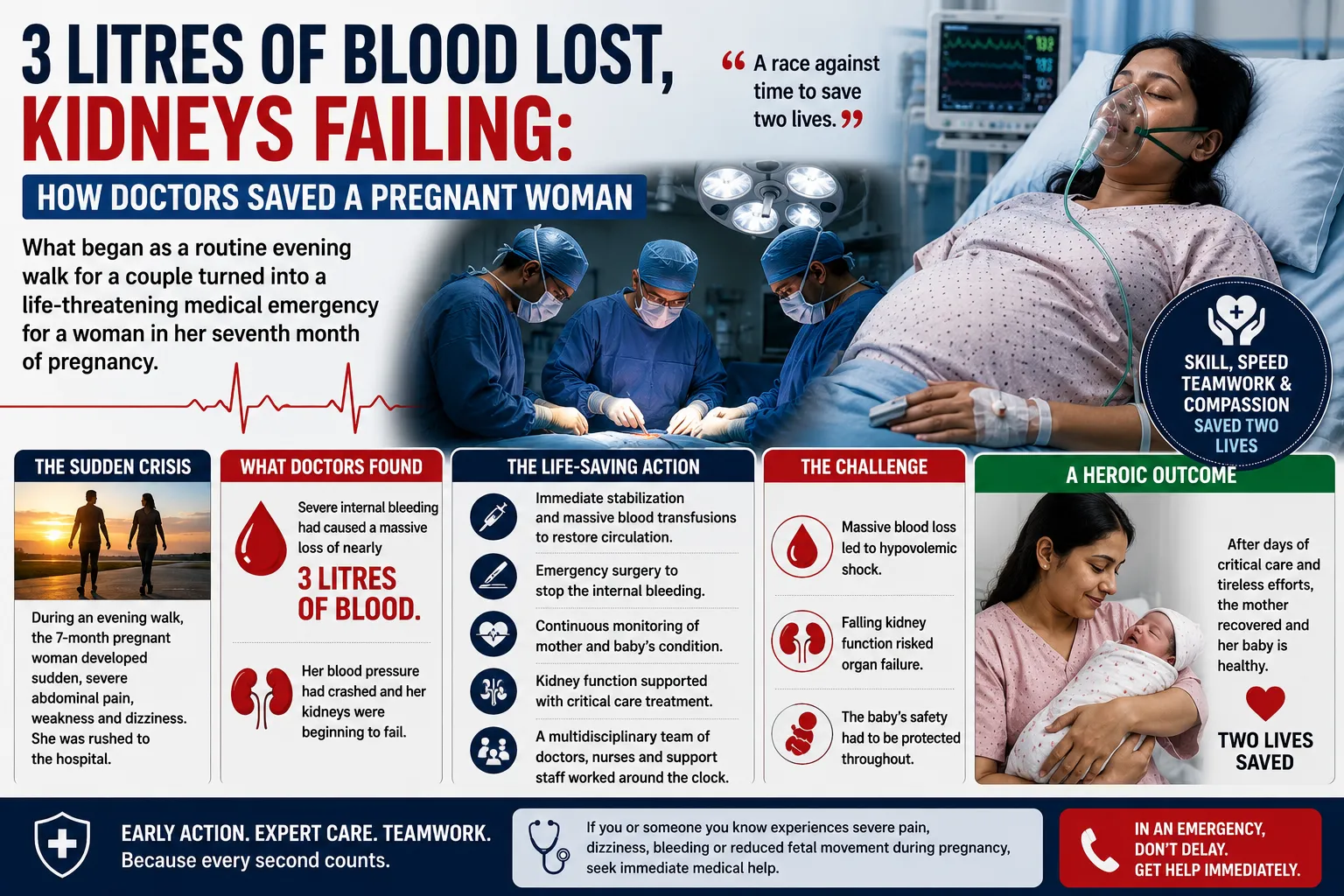
What began as an ordinary evening walk for a couple quickly turned into a life-threatening medical emergency that tested the skills, coordination, and determination of an entire healthcare team. A pregnant woman in her seventh month suddenly found herself battling severe internal bleeding, rapidly deteriorating kidney function, and a critical loss of blood that pushed her body toward organ failure.
Thanks to the swift actions of doctors, surgeons, critical care specialists, anesthesiologists, nurses, and blood bank teams, both the mother and her unborn child survived a crisis that could easily have ended in tragedy.
The incident serves as a powerful reminder of how quickly medical emergencies can develop during pregnancy and highlights the importance of rapid diagnosis, multidisciplinary care, and advanced emergency medicine.
A Routine Evening Takes a Dangerous Turn
Pregnancy is often accompanied by various physical changes, many of which are considered normal. Mild discomfort, fatigue, back pain, and occasional abdominal sensations are common experiences for expectant mothers.
However, some symptoms may signal a serious medical emergency.
In this case, what started as a normal evening walk soon changed when the woman experienced sudden and severe abdominal discomfort. Initially, the symptoms may not have appeared alarming enough to suggest a life-threatening condition. However, her situation worsened rapidly.
As the pain intensified, additional symptoms began to emerge. Weakness, dizziness, falling blood pressure, and signs of physical distress indicated that something far more serious was happening internally.
Recognizing the urgency of the situation, family members sought immediate medical assistance.
That decision proved crucial.
The Hidden Danger of Internal Bleeding
One of the greatest challenges in emergency medicine is diagnosing internal bleeding before irreversible damage occurs.
Unlike external injuries, internal hemorrhage can progress silently while significant amounts of blood accumulate inside the body.
In pregnant women, diagnosis can be even more complicated because normal pregnancy symptoms sometimes overlap with early warning signs of medical emergencies.
By the time the patient reached the hospital, doctors discovered she had already lost nearly three litres of blood.
To understand the severity of that figure, an average adult woman typically has around four to five litres of blood circulating throughout her body. Losing such a large volume in a short period can trigger hypovolemic shock, a condition in which the body is unable to deliver sufficient oxygen and nutrients to vital organs.
Without immediate treatment, shock can rapidly become fatal.
How Blood Loss Affects the Body
Massive blood loss places extraordinary stress on nearly every organ system.
As blood volume decreases, blood pressure falls. The heart must work harder to maintain circulation, while organs begin receiving less oxygen-rich blood.
The brain may experience dizziness or loss of consciousness.
The lungs struggle to compensate for reduced oxygen delivery.
The liver and digestive system receive less blood flow.
Perhaps most concerning is the impact on the kidneys.
The kidneys depend on a constant supply of blood to filter waste products and regulate fluid balance. When circulation drops dramatically, kidney function can deteriorate quickly.
In severe cases, acute kidney injury can develop within hours.
This appeared to be happening in the patient’s case as doctors observed signs that her kidneys were beginning to fail.
Pregnancy Makes Emergencies More Complex
Medical emergencies during pregnancy involve two patients rather than one.
Doctors must simultaneously protect the mother’s life while monitoring the health and safety of the unborn child.
Reduced blood flow in the mother can directly affect the fetus because oxygen and nutrients reach the baby through the placenta.
When maternal circulation becomes unstable, fetal distress may develop rapidly.
This creates a race against time.
Healthcare teams must stabilize the mother while continuously evaluating fetal well-being and determining whether emergency delivery is necessary.
In many high-risk pregnancies, multidisciplinary teams work together to make these critical decisions in real time.
The Race to Save Two Lives
Upon evaluating the patient, doctors recognized that immediate intervention was essential.
Multiple specialists became involved simultaneously.
Emergency physicians focused on stabilizing blood pressure and circulation.
Obstetricians monitored the pregnancy and assessed fetal health.
Critical care specialists managed organ support.
Anesthesiologists prepared for possible emergency surgery.
Laboratory teams worked urgently to analyze blood samples.
The blood bank mobilized supplies needed for transfusion.
Such coordination is often the difference between survival and tragedy during complex medical emergencies.
Every minute matters when severe blood loss is involved.
The Role of Blood Transfusions
One of the most important components of treatment was replacing the blood the patient had lost.
Blood transfusions are frequently lifesaving in cases of massive hemorrhage.
Packed red blood cells help restore oxygen-carrying capacity.
Plasma helps replace clotting factors.
Platelets support the body’s ability to control ongoing bleeding.
Without adequate blood replacement, organs continue to suffer from oxygen deprivation even after the source of bleeding is addressed.
In severe obstetric emergencies, rapid transfusion protocols often play a decisive role in improving survival rates.
The availability of blood products and efficient transfusion services can significantly influence patient outcomes.
Managing Kidney Failure
While controlling the bleeding remained the top priority, doctors also had to address the effects of reduced circulation on the kidneys.
Acute kidney injury can become a serious complication following massive blood loss.
The kidneys may temporarily lose their ability to filter waste products from the bloodstream, leading to dangerous chemical imbalances and fluid retention.
Fortunately, early restoration of blood flow often allows kidney function to recover.
Critical care teams closely monitor urine output, electrolyte levels, blood chemistry, and overall organ performance during recovery.
The patient’s improvement after emergency treatment demonstrated the importance of timely intervention before permanent damage occurs.
The Importance of Multidisciplinary Care
Modern medicine increasingly relies on collaborative care models, particularly in high-risk situations.
Complex emergencies rarely involve a single specialty.
In obstetric critical care, successful outcomes often depend on seamless coordination among multiple departments.
The patient’s survival highlights how modern hospitals combine expertise from obstetrics, surgery, anesthesia, intensive care, transfusion medicine, radiology, nephrology, and nursing services.
Each team contributes specialized knowledge while working toward a common goal.
This integrated approach has dramatically improved survival rates for many previously fatal pregnancy complications.
Lessons for Expectant Mothers
Although severe internal bleeding during pregnancy is uncommon, the case underscores the importance of recognizing warning signs.
Pregnant women should seek immediate medical attention if they experience:
-
Sudden severe abdominal pain
-
Persistent dizziness or fainting
-
Rapid heartbeat
-
Difficulty breathing
-
Unexplained weakness
-
Significant swelling
-
Reduced fetal movement
-
Any symptom that feels unusual or severe
Early medical evaluation can often identify complications before they become life-threatening.
Regular prenatal care also remains one of the most effective ways to detect potential risks and ensure timely intervention when needed.
Advances in Maternal Healthcare
Over the past several decades, improvements in maternal healthcare have significantly reduced deaths from pregnancy-related complications.
Advanced imaging technologies, blood banking systems, intensive care medicine, fetal monitoring, emergency surgery, and specialized obstetric units have transformed outcomes for high-risk pregnancies.
Cases that once carried extremely poor survival rates are now increasingly manageable when patients receive prompt treatment.
However, success still depends heavily on early recognition and rapid access to skilled medical care.
Conclusion
The dramatic rescue of a pregnant woman who lost nearly three litres of blood and developed signs of kidney failure stands as a testament to modern emergency medicine and multidisciplinary healthcare.
What began as a routine evening walk became a battle against time, shock, organ dysfunction, and life-threatening complications. Through rapid diagnosis, blood transfusions, surgical intervention, intensive monitoring, and coordinated teamwork, doctors were able to save both mother and child.
Beyond its medical significance, the case highlights a broader lesson: during pregnancy, symptoms should never be ignored when they suddenly become severe or unusual. Early intervention can mean the difference between recovery and tragedy.
For the family involved, what could have been a devastating loss instead became a story of survival, resilience, and the extraordinary capabilities of modern healthcare.