
The Public Accounts Committee of Parliament has sought a detailed response from the Indian Railways on a recent Comptroller and Auditor General report that highlights persistent and widespread deficiencies in passenger amenities and sanitation at railway stations. The panel has specifically questioned why premier NSG-1 category stations, including CSMT, Howrah, Sealdah, New Delhi and Mumbai Central, continue to fall short on core facilities such as drinking water, fans, seating and signage.
Key Findings of the CAG Audit
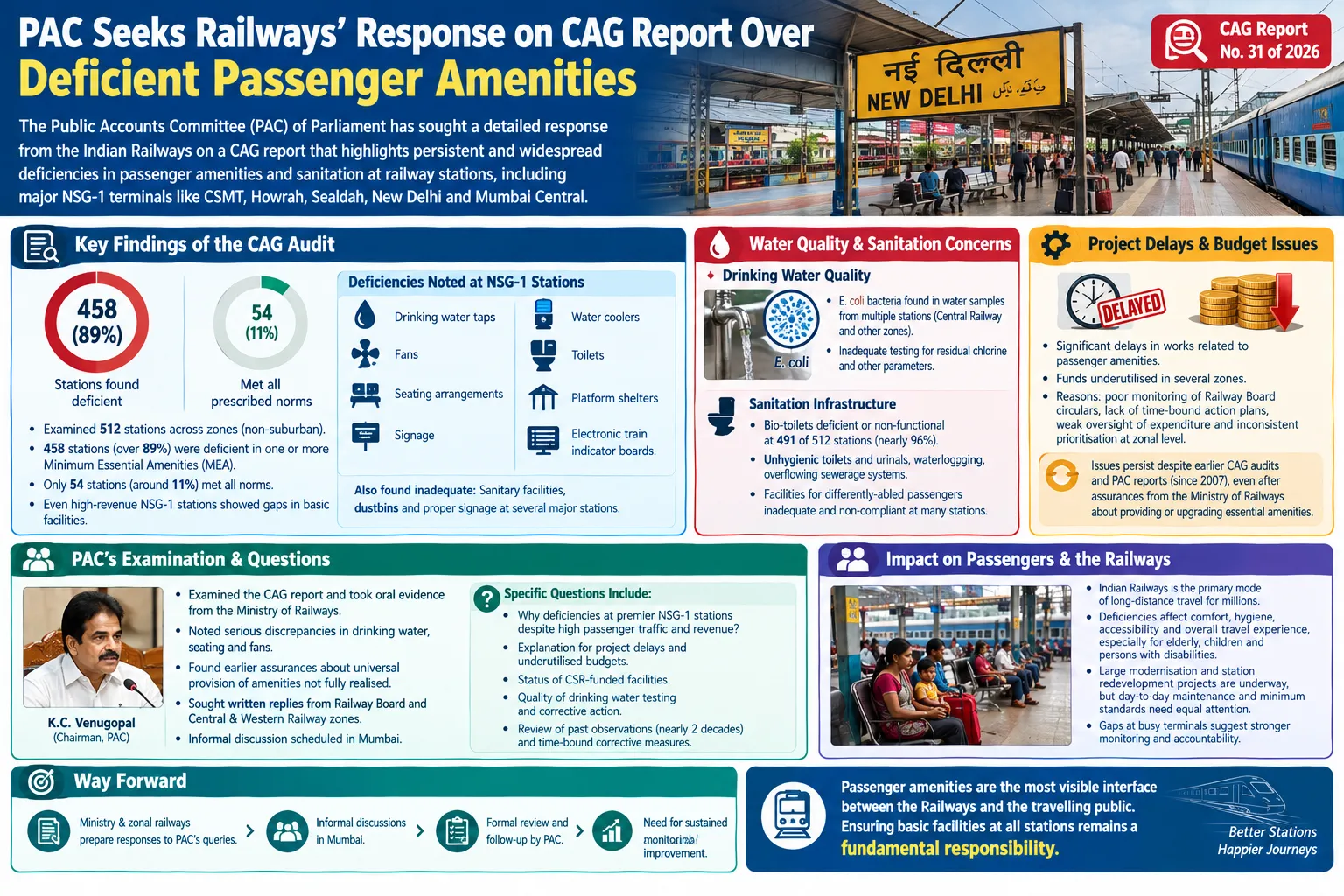
The CAG’s Report No. 31 of 2026 examined passenger amenities and sanitation at non-suburban railway stations. Auditors inspected a sample of 512 stations across zones. Of these, 458 stations — more than 89 per cent — were found deficient in one or more Minimum Essential Amenities prescribed by the Railway Board. These amenities include drinking water taps, seating arrangements, toilets, platform shelters, fans, water coolers and proper signage.
Only 54 stations, or roughly 11 per cent of those surveyed, met all the prescribed norms without shortfall. The deficiencies were not limited to smaller or less busy stations. Even high-revenue, high-footfall NSG-1 stations, which handle the largest passenger volumes and generate substantial earnings, showed gaps in basic facilities.
At several NSG-1 terminals, auditors recorded shortfalls in drinking water taps, fans, water coolers, seating and signage. Sanitary facilities, dustbins and electronic train indicator boards were also found inadequate at select major stations. The report noted that these problems pointed to gaps in routine maintenance and monitoring rather than the complete absence of infrastructure.
Concerns Over Water Quality and Sanitation
One of the more serious findings related to drinking water quality. Bacteriological analysis revealed the presence of E. coli bacteria in water samples from multiple stations, including locations under Central Railway and other zones. The audit also flagged inadequate testing for residual chlorine and other parameters at several sites.
Sanitation infrastructure drew sharp criticism. Bio-toilets, long projected as a major improvement, were found deficient or non-functional at 491 of the 512 stations inspected — nearly 96 per cent. Unhygienic toilets and urinals, waterlogging and overflowing sewerage systems were reported across a large number of stations. Facilities for differently-abled passengers remained inadequate and non-compliant with statutory requirements in many places, including at some of the busiest terminals.
Project Delays and Budget Underutilisation
Beyond the physical shortfalls, the CAG report highlighted systemic issues in project execution. A significant proportion of works related to passenger amenities faced delays. Funds allocated under the relevant plan heads for improving facilities were underutilised in several zones. The audit attributed the persistence of problems to inadequate monitoring of Railway Board circulars, absence of time-bound action plans, weak oversight of expenditure and inconsistent prioritisation at the zonal level.
The findings echo observations made in earlier CAG audits and previous PAC reports dating back to 2007. Despite repeated assurances from the Ministry of Railways that minimum essential amenities had been provided or were being upgraded, ground-level inspections continued to reveal shortfalls.
PAC’s Examination and Specific Questions
The Public Accounts Committee, chaired by K.C. Venugopal, examined the CAG report and took oral evidence from representatives of the Ministry of Railways. The panel observed serious discrepancies in the provision of basic facilities such as drinking water, seating arrangements and fans. It noted that assurances given years earlier regarding universal provision of drinking water and other amenities had not been fully realised.
The committee has sought written replies from the Railway Board as well as from Central and Western Railway zones to a detailed set of questions. An informal discussion with officials is scheduled in Mumbai. Among the specific points raised is the continued presence of deficiencies at premier NSG-1 stations despite their high passenger traffic and revenue contribution. The panel has also asked for explanations on project delays, underutilisation of budgets, non-operational facilities funded through corporate social responsibility, and the quality of drinking water testing and corrective action.
The PAC has directed the Ministry to review its earlier observations spanning nearly two decades and to submit a comprehensive response detailing corrective measures within a stipulated timeframe. A follow-up meeting is expected after the response is received.
Implications for Passengers and the Railways
Indian Railways remains the primary mode of long-distance travel for a large section of the population. Non-suburban stations handle hundreds of crores of passengers annually. Deficiencies in basic amenities affect comfort, hygiene, accessibility and overall travel experience, particularly for elderly passengers, families with children and persons with disabilities.
The report underscores that while large-scale modernisation programmes and station redevelopment initiatives are underway, day-to-day maintenance and the consistent delivery of minimum standards require equal attention. Gaps at even the busiest terminals suggest that monitoring mechanisms and accountability at the operational level need strengthening.
For the Railways, the PAC’s intervention adds parliamentary scrutiny to the audit findings. The demand for time-bound action and detailed justification of past performance places pressure on the administration to demonstrate measurable improvement rather than rely on earlier claims of progress.
Path Ahead
The coming weeks will see the Ministry and zonal railways prepare responses to the committee’s queries. The informal discussions in Mumbai and the subsequent formal review will test the Railways’ ability to present credible plans for closing the identified gaps. Sustained follow-up by the PAC, combined with internal monitoring reforms, will be necessary if the deficiencies flagged in successive audits are finally to be addressed in a lasting manner.
Passenger amenities form the most visible interface between the Railways and the travelling public. Ensuring that even the most basic facilities are reliably available at stations of all categories remains a fundamental responsibility. The latest CAG findings and the PAC’s firm response have once again brought this responsibility into sharp focus.
Read more – todaybestoffers.info
 Martin