
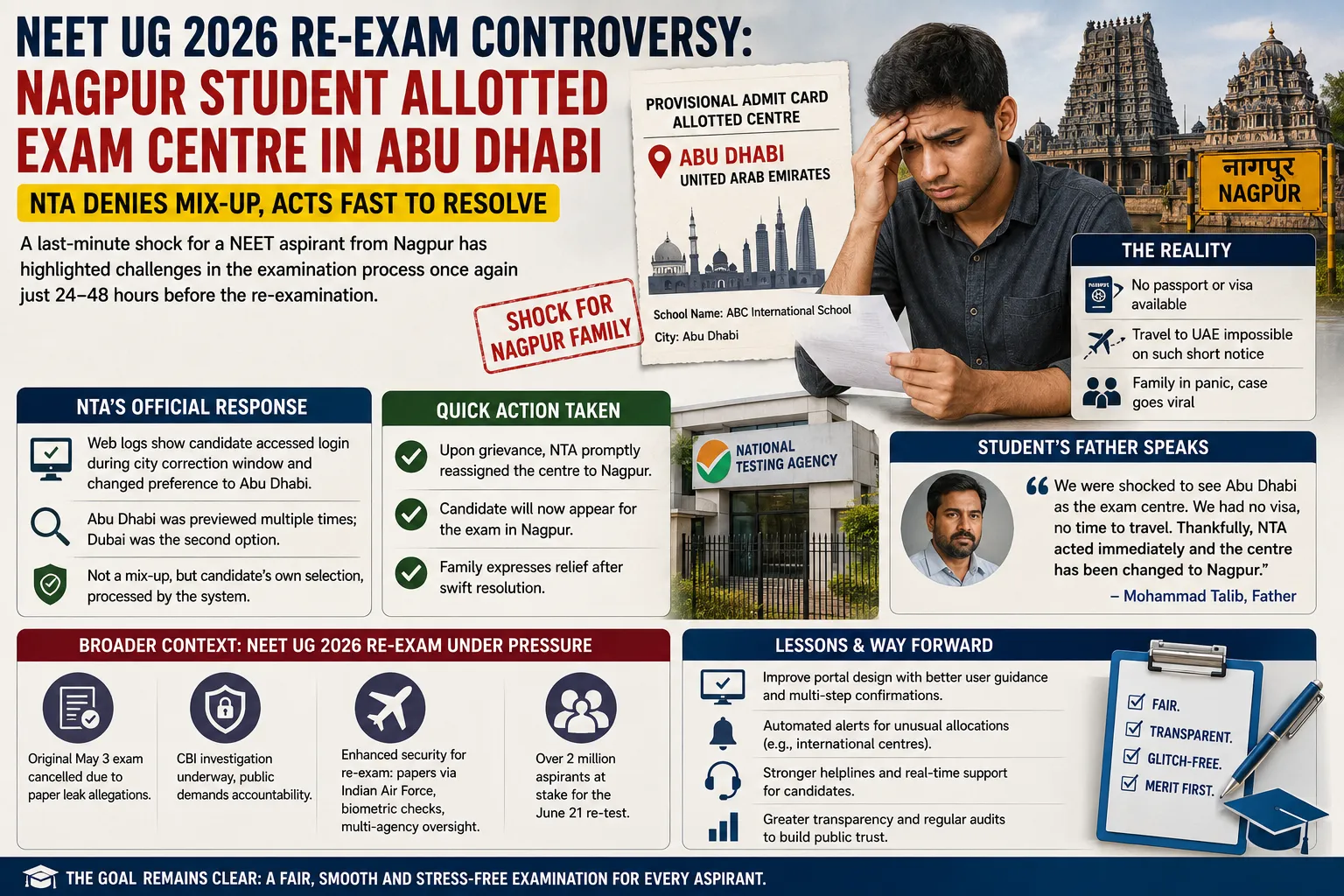
As the National Testing Agency (NTA) prepares to conduct the NEET UG 2026 re-examination on June 21 under intense scrutiny, a last-minute controversy involving a Nagpur aspirant has once again spotlighted challenges in the examination process. A student from Nagpur was allotted an examination centre in Abu Dhabi, United Arab Emirates, prompting widespread concern and questions about logistical feasibility just 24-48 hours before the test. The NTA has firmly denied any administrative mix-up, asserting that the candidate personally selected Abu Dhabi during the city correction window, while promptly accommodating a subsequent request to shift the centre back to Nagpur.
The incident involves Abdullah Mohammad Talib, a NEET aspirant who had been diligently preparing for the re-test following the cancellation of the original May 3 examination due to paper leak allegations. Upon downloading his provisional admit card, the family was shocked to discover the assigned venue listed as a school in Abu Dhabi. With no passport or visa readily available and travel to the UAE being logistically impossible on such short notice, the case quickly gained traction on social media and news outlets, amplifying existing frustrations over the NTA’s handling of the high-stakes medical entrance test.
NTA’s Official Response and Clarification
In response to the growing outcry, the NTA issued a detailed clarification emphasizing transparency in its digital records. According to the agency, web activity logs showed that the candidate had accessed his registered login during the open correction window and explicitly changed his city preference to Abu Dhabi, previewing the selection multiple times. Dubai was reportedly listed as the second option. The NTA maintained that this was not an erroneous allotment but a reflection of the candidate’s own choices, which the system processed accordingly.
Despite this, the agency demonstrated responsiveness by acting swiftly on the family’s grievance. Officials confirmed that the centre was promptly reassigned to a suitable location in Nagpur, allowing the student to appear for the examination without disruption. The father, Mohammad Talib, expressed relief after the resolution, acknowledging the NTA’s intervention. This quick correction helped mitigate immediate distress, though the episode has reignited broader debates about the robustness of the NTA’s candidate portal and communication protocols.
Broader Context: The NEET Re-Examination Under Pressure
The NEET UG 2026 re-test comes in the wake of significant turmoil. The original examination was canceled following widespread allegations of paper leaks, leading to a CBI investigation and public demands for accountability. For over two million aspirants, including those like Abdullah who invested additional weeks of preparation, the stakes remain extraordinarily high. The re-examination is being conducted with enhanced security measures, including air transport of question papers by the Indian Air Force, biometric checks, and multi-agency oversight to restore credibility.
International centres, including in the UAE (such as Dubai and Sharjah), are part of the NTA’s standard framework to accommodate candidates, particularly those from the Indian diaspora or with preferences for overseas testing. However, allocating such a centre to a domestic candidate from Nagpur—without clear intent—highlighted potential gaps in verification processes, even if records pointed to candidate-initiated changes. Critics argue that clearer guidelines and real-time confirmation mechanisms could prevent similar confusion in future cycles.
Systemic Challenges Facing the NTA
This episode is the latest in a series of operational hiccups for the NTA, which has faced criticism over centre allocations, technical glitches, and communication lapses in previous examinations. In the re-exam FAQs, the agency had already noted that centres for the re-test might differ from the original and would be allotted randomly based on selected cities. While this policy aims for fairness and logistical efficiency, last-minute surprises erode student confidence, particularly when international locations are involved.
Parents and educators emphasize the immense pressure on aspirants. Preparing for NEET demands months of focused study, and administrative uncertainties can trigger anxiety, especially for students from non-metropolitan areas like Nagpur. The family’s initial distress—stemming from concerns over travel documents and costs—underscores the need for more empathetic and proactive support systems, such as dedicated helplines and advance provisional centre previews.
Implications for Students and Reforms
For Abdullah Talib and thousands like him, the resolution offers reassurance that individual grievances can be addressed promptly. However, the incident serves as a microcosm of larger issues plaguing competitive examinations in India: the balance between technological efficiency and human-centric design. As digital portals handle millions of applications, ensuring intuitive interfaces, audit trails, and fallback options becomes critical.
Experts recommend several improvements. These include mandatory multi-factor confirmations for significant changes like city preferences, automated alerts for unusual allocations (e.g., international centres for domestic applicants), and extended correction windows with better user guidance. Additionally, greater transparency in publishing anonymized data on centre allotments could build public trust.
On a positive note, the NTA’s swift action in this case demonstrates willingness to prioritize student welfare once issues surface. With the re-examination scheduled for June 21, authorities have ramped up coordination with state governments and security agencies to ensure smooth conduct. Success in this re-test will be measured not only by leak-proof execution but also by minimizing administrative oversights that distract from academic merit.
Lessons for Future Examination Cycles
The Abu Dhabi allotment controversy, though resolved, highlights the evolving complexities of managing a pan-India (and international) entrance examination. In an era of heightened digital expectations, candidates and families anticipate seamless experiences. The NTA must continue investing in robust IT infrastructure, regular audits, and stakeholder feedback mechanisms to align processes with ground realities.
For aspirants, the episode reinforces the importance of double-checking all portal activities during correction windows and maintaining open communication with authorities. Broader reforms—such as diversifying admission pathways, reducing over-reliance on a single test, and enhancing mental health support—could alleviate systemic pressures on students pursuing medical careers.
As the June 21 re-examination unfolds, all eyes remain on the NTA to deliver a fair and glitch-free process. The Nagpur case, while briefly disruptive, ultimately resolved in the student’s favor, offering a reminder that accountability and rapid response remain vital in rebuilding trust. India’s future doctors deserve an examination system that matches their dedication—one defined by precision, fairness, and unwavering focus on merit.
Moving forward, sustained dialogue between the testing agency, students, parents, and policymakers will be essential to refine processes and prevent recurrence of such avoidable anxieties. The goal remains clear: safeguarding the integrity and accessibility of one of India’s most pivotal educational gateways.